Stop Losing Points and Score Higher on IELTS Reading Short Answer Questions: Locating Keywords and Checking Word Count
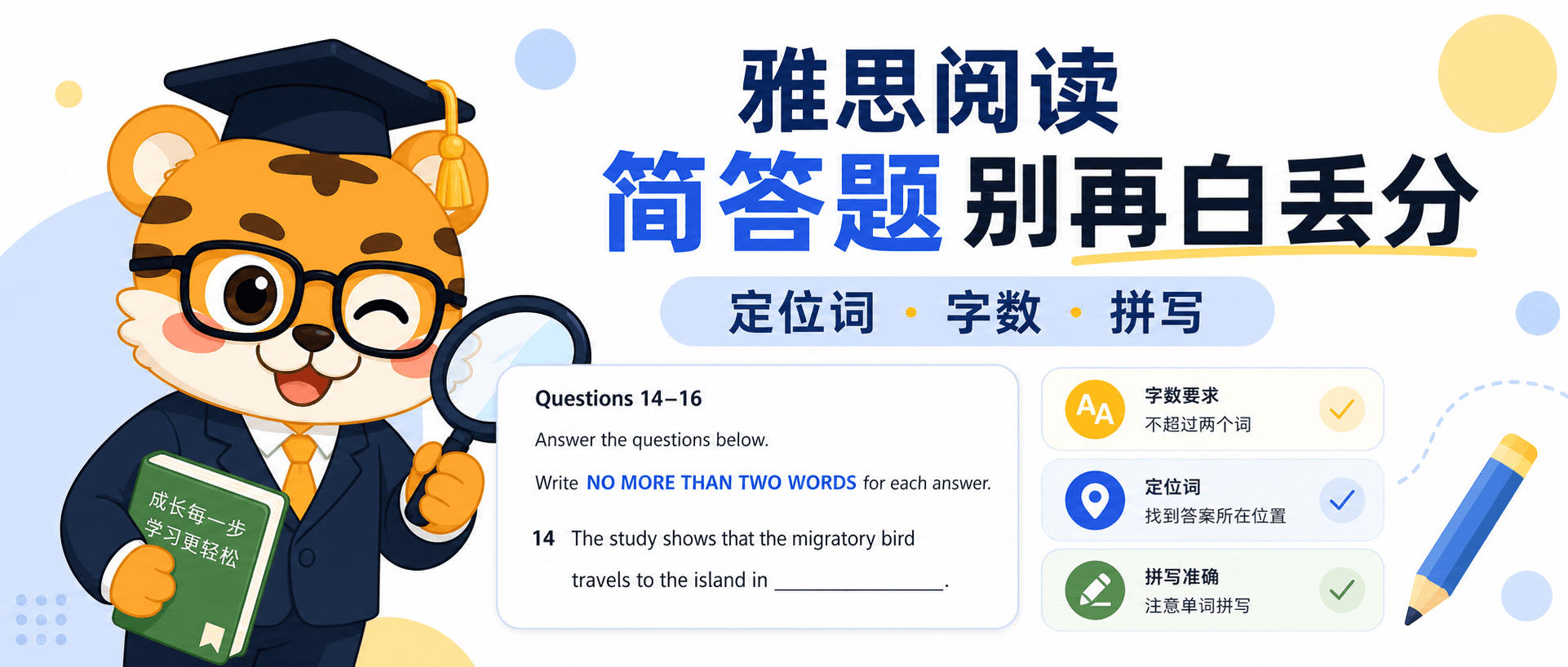
Short-answer questions in IELTS Reading seem straightforward—just find the answer in the text and fill it in. Many students find the relevant sentence but still get the answer wrong due to poorly localized answers, copying too many words, forgetting to check word counts, or misspellings. Short-answer questions must be answered using words or numbers found in the article. The instructions will state the maximum number of words allowed (e.g., "NO MORE THAN TWO WORDS AND/OR A NUMBER"). This section tests detail localization and understanding without requiring you to translate the entire text.
Special words in the question help you find paragraphs quickly
Start by reading the questions. Names, places, years, organization names, and rare specialized terms are easy to scan for in the text. For example, if the question asks "Where did the first experiment take place?", the phrase "first experiment" might be rewritten as "initial study," while the place name remains unchanged.
There are two types of words in the question prompt: numbers, proper nouns, and rare nouns can be scanned directly, while when, where, why, how many are used to determine the scope of the answer. If the question lacks obvious proper nouns, pick two meaningful nouns and consider how they might be replaced. Environmental damage might be written as "harm to the natural world." If you only focus on the original words, you might mistakenly think an answer doesn't exist when the text simply uses synonyms.
Answers to short-answer questions usually appear in order
Generally, answers to short-answer questions appear in the order they are presented in the text. Once you locate the position for Question 11, Question 12 is usually found further ahead. This order saves time flipping back and forth and helps you determine if your localization is off. For instance, if Question 14 is found in the third paragraph, start checking from after that paragraph for Question 15. If you can't find it, look ahead a little further, then check the synonyms in the question. Don't rush back to the beginning of the article, or you will easily lose track of where the answer is.
The sequence only narrows the scope; it doesn't replace understanding. Once you see a familiar word, confirm that the answer corresponds to the intent of the question.
Question words determine what the answer should look like
When usually leads to a time, Where to a location, Who to a person or organization, Why to a cause, and How many to a number. What might ask for an item, method, name, or an event, so you need to infer the context. When practicing, you can write a small note next to the question prompt, like "Location" or "Reason." Just one or two words can prevent you from being distracted by irrelevant details once in the text. For example, if a question asks for a cause but a year appears prominently next to it in the text, don't be tempted to fill in the year.
Ensure the answer flows naturally when plugged back into the question. If the question asks "What did the researchers use to measure the temperature?", the answer should be the tool or method used.
Word count limits determine if you get the point
Even if the meaning is correct, you will lose points if you exceed the limit. If the instructions say "NO MORE THAN ONE WORD", you cannot write two. When it reads "NO MORE THAN TWO WORDS AND/OR A NUMBER," a number can appear with a word, but it must adhere to the request.
The original text often contains full phrases, while the question only needs a part of it. For example, if the text says "a new type of solar panel," and the question prefix already includes "a new type of," the answer is simply "solar panel."
After filling it in, read the completed sentence to check for grammatical fit. Look at whether an article or preposition precedes the blank—is a noun, verb, or adjective required? Hyphenated words and number formats must also be handled as specified. Don't assume it's safer to write a few extra words; following the instructions is the only rule.
Singular, plural, and spelling should all be checked at the very end
Answers are generally taken directly from the text, so spell them as they appear. When you identify an answer, first check for articles like a, an, the and quantifiers like many, several, then verify the singular or plural form. Long words, names, and places are easy to miss letters in. Even in computer exams, check for extra spaces or keying in letters incorrectly; auto-suggestions cannot tell you if the suggested word aligns with the question's intent.
Review errors to identify localization vs. typing mistakes
When reviewing questions, distinguishes between localization errors and typing errors. After completing a set, categorize mistakes into four types: didn't find the text, found it but misunderstood the object, exceeded the word count, or spelling and plural errors. Don't just label everything as "carelessness."
- If you consistently find the answer but copy too many words, practice checking the word count.
- If you consistently can't find an answer, practice identifying keywords and synonym replacement.
You can start by practicing a set of short-answer questions without a time limit. First pass: do localization only. Second pass: fill in the answers. Finally, spend two minutes checking word count, grammar, and spelling. Once familiar, return to full-length practice.
You can use Youshow IELTS for reading practice, saving errors, and reviewing answer analysis. You can download it from the Apple App Store or visit the official website at https://ielts.youshowedu.com/en. Practice a small group every day and clearly record the cause of each error; your performance in short-answer questions will no longer rely on luck.
To stop losing points, prioritize keywords, follow the question order, confirm the question word and answer object, and finally check word counts, singulars/plurals, and spelling. Follow these steps to significantly reduce lost points.

Continue this topic
Related reading and practice

Turn blog tips into your actual IELTS training flow
Don't just read tips. On the platform you can put speaking practice, real test drills and review into one steady prep rhythm.
- AI speaking mock practice
- Structured Cambridge IELTS practice
- Continue your personal prep rhythm after signing in
- Extend to writing feedback and question banks later