What is C1 level English in IELTS?
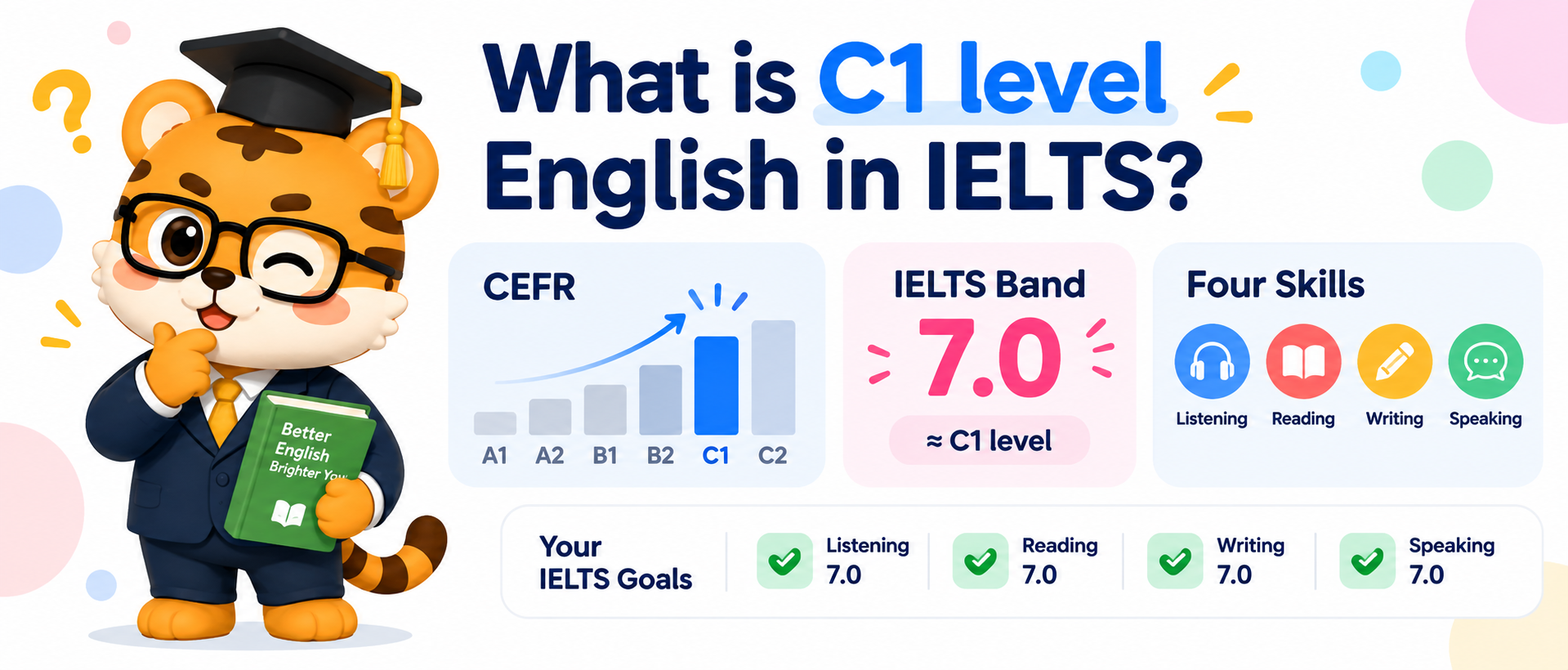
Many people search for “what is C1 level English in IELTS?” after seeing C1 on a university, work, or visa page. C1 comes from the Common European Framework of Reference for Languages, or CEFR. It describes someone who can deal with fairly complex English in study, work, and daily communication. In IELTS terms, C1 is often placed around band 7.0 to 8.0. This is a useful guide, but it is not one fixed conversion used by every organisation.
C1 means handling complex English with reasonable control
C1 does not mean knowing every word or speaking without mistakes. A C1 user can usually follow lectures, news, and longer texts with limited help. They can explain an opinion, add reasons and examples, and show a limitation or change of view. Small grammar mistakes may still happen, but they do not normally stop the message.
CEFR describes what a person can do with language, while IELTS measures performance in one particular test. You may be close to C1 in reading but still have a 6.0 in speaking. You may also have a good overall score with writing as your weakest skill. That is why one total score cannot describe every part of your English equally well.
IELTS band 7.0 is a common C1 reference point
Band 7.0 is commonly used as a C1 reference, and band 8.0 is also often placed within C1. Some conversion tables place 8.5 and 9.0 in C2. Band 6.5 is usually near the border between B2 and C1, so a 6.5 should not automatically be called stable C1 English.
The exact rule belongs to the organisation receiving your result. One university may ask for an overall 7.0 with no skill below 6.5. Another may ask for 7.0 in every skill. Professional registration and visa routes can also specify Academic, General Training, or IELTS for UKVI. The test version matters as much as the number.
An overall 7.0 can hide a weaker skill
The IELTS overall band is calculated from listening, reading, writing, and speaking. For example, scores of 8.0, 7.5, 6.5, and 6.5 can produce an overall 7.0 after rounding. That does not mean the writing and speaking scores meet a requirement for C1 in every skill.
Write your target in two lines before you start preparing. The first line should show the overall score. The second should show the minimum score for each skill. If the requirement says C1 in all skills, improving only reading and listening will not solve the application problem. Writing and speaking often need longer, more focused practice.
Your C1 target depends on the reason for taking IELTS
University requirements often sit around 6.5 or 7.0, but courses such as nursing, teaching, and law may ask for higher skill scores. A work visa or professional body may use a different threshold. The label C1 tells you the broad level; it does not always tell you the exact IELTS number accepted in your case.
Turn the requirement into a full sentence, such as “Academic overall 7.0, no skill below 6.5, with a valid result at the application date”. Also check whether the organisation accepts One Skill Retake. This small check can prevent a frustrating situation where your score looks good but the test format is not accepted.
C1 practice needs accuracy as well as longer answers
C1 preparation is not about writing extremely long sentences. In writing, you need to answer the task directly, connect paragraphs clearly, and use examples with enough detail. In speaking, you need to continue an answer, explain an idea in another way, and respond when the topic changes. Listening and reading practice should include complex sentences, paraphrase, attitude, and unfamiliar topics.
Keep three error groups: you could not understand it, you could not hear it, or you understood it but could not produce it. The first group needs vocabulary and sentence work. The second needs listening for connected speech and key details. The third needs recording, timed writing, and repeated correction.
If you want short practice for all four skills in one place, you can try YoushowIELTS at https://ielts.youshowedu.com. It offers listening, reading, writing, and speaking practice, with timed work and review tools. For a C1 goal, a short daily session plus regular full mocks is a practical routine.
The institution’s own score table is the final answer
There is no single IELTS score that works for every C1 application. Treating 7.0 as a common starting point is reasonable, but the university, employer, visa office, or professional body decides what it accepts. Check the official page for the test type, individual skill scores, result validity, and deadline.
CEFR helps you understand the direction. The actual IELTS conditions decide your study plan. Once you write down the overall score, skill minimums, test type, and deadline, the C1 target becomes much easier to prepare for.
Continue this topic
Related reading and practice

Turn blog tips into your actual IELTS training flow
Don't just read tips. On the platform you can put speaking practice, real test drills and review into one steady prep rhythm.
- AI speaking mock practice
- Structured Cambridge IELTS practice
- Continue your personal prep rhythm after signing in
- Extend to writing feedback and question banks later