What Is a B2 Level English IELTS Score? The 5.5–6.5 Range Explained [2026 Guide]
![What Is a B2 Level English IELTS Score? The 5.5–6.5 Range Explained [2026 Guide]](/blog-covers/what-is-b2-level-english-ielts-score-2026/cover-en.png)
When people search for a B2 level English IELTS score, they usually want one number. Is B2 an IELTS 5.5, a 6.0 or a 6.5?
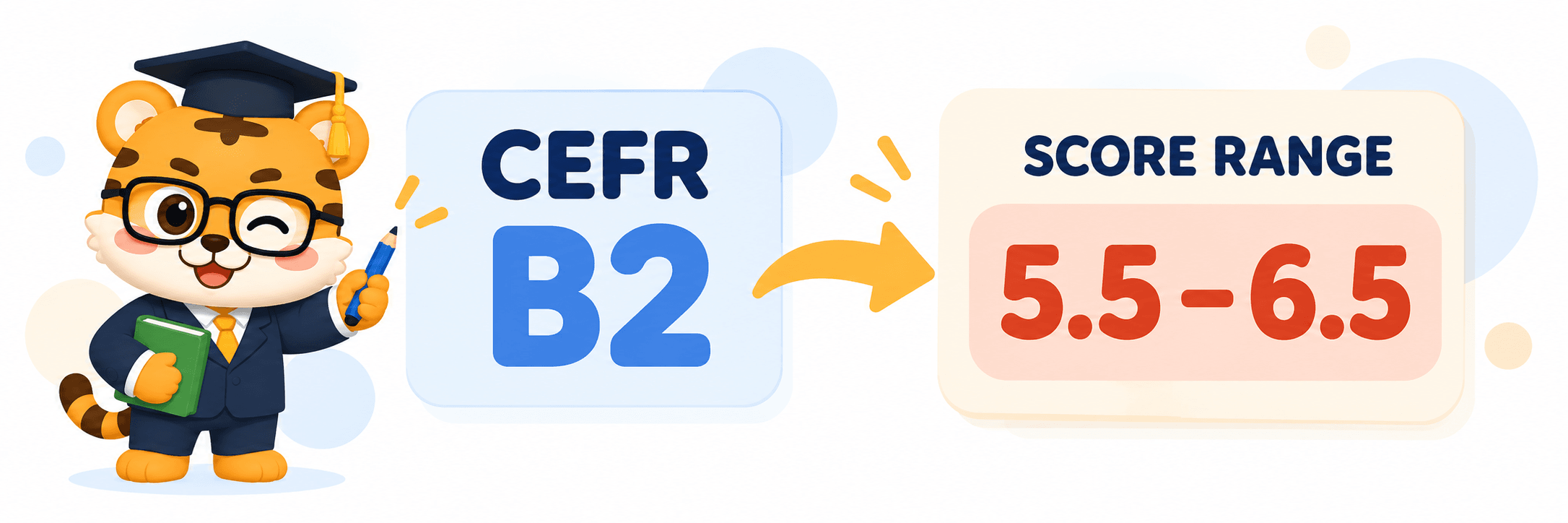
The honest answer is a range. IELTS materials commonly place CEFR B2 around an overall IELTS band score of 5.5–6.5, but IELTS also explains that the CEFR and IELTS are not a one-to-one conversion. When a score sits near a boundary, the requirement written by the organisation receiving your application matters more than a general chart.
I will break the question into three parts. First, what the B2 range means. Then, why an overall score is different from your four component scores. Finally, what to do when a course, visa route or employer asks for B2.
01 What B2 means and why IELTS 5.5–6.5 is the usual reference
The Common European Framework of Reference for Languages, or CEFR, describes language ability from A1 and A2 through B1, B2, C1 and C2. B2 is generally described as an independent-user level. You are no longer limited to short everyday exchanges. You can understand more complex material on familiar or relevant subjects and explain your own views with reasonable clarity.
On the IELTS scale, official guidance commonly aligns B2 with an overall score between 5.5 and 6.5. So when you see CEFR B2 on a university, work or visa page, 5.5, 6.0 and 6.5 are the sensible IELTS scores to investigate first. Do not turn one of them into a universal pass mark.
Why is there a range? IELTS reports performance on a continuous nine-band scale, while CEFR is a framework for describing levels of ability. The tests have different purposes, tasks, candidate populations and measurement scales. IELTS therefore warns that its bands and CEFR levels do not line up as a precise conversion table.
There is another word worth noticing, overall. The B2 comparison refers to an overall band score, not to every IELTS skill automatically being at B2. Your Listening, Reading, Writing and Speaking scores can be different, which is why an application may add minimum scores for individual components.
Treat 5.5–6.5 as a useful direction, not as a ticket that works everywhere. The final reference is the requirement from the university, visa office, employer or professional body receiving your documents. An organisation may ask for an overall 5.5, an overall 6.0, or 5.5 in every component. Those are different targets.
02 IELTS 5.5, 6.0 and 6.5 are not interchangeable

Once candidates see the B2 range, they often ask whether any score inside it is enough. The answer depends on the exact wording of the application.
Your overall band score comes from the average of the four components and is reported under IELTS rounding rules. An application can then add another condition, such as an overall 6.0 with no component below 5.5. If your overall score reaches 6.0 but Writing is 5.0, you may still fail that requirement.
Some organisations consider only the overall score. Others check every component. A course may set a separate threshold for Writing or Speaking. A B2 requirement can also appear in university admission, professional registration, employment and visa routes, and these routes do not share one universal standard.
For example, some UK visa routes that require CEFR B2 ask for at least 5.5 in each of the four sections of an IELTS for UKVI test. That is a specific visa rule, not a definition of every B2 application. Do not use it as a shortcut for all universities or all immigration pathways.
When you find a B2 requirement, record four details, the accepted test type, the overall score, the minimum score in each component and the date by which the result must be valid. Academic, General Training, IELTS for UKVI and Life Skills are related products, but they are not automatically interchangeable.
The B2 label can also help you choose what to practise. In Listening and Reading, you need to follow the main idea, details and paraphrase in more complex material. In Writing, you need to answer the task clearly and organise explanations. In Speaking, you need to keep developing an answer rather than stopping after one short sentence. You do not need to sound like a native speaker, but you do need to keep your meaning moving when a question becomes less familiar.
That distinction matters. A candidate may recognise many words and still struggle to finish a timed Task 2 essay. Someone may understand a recording and still lose marks through spelling or missed details. B2 is not a vocabulary badge. It is closer to the ability to complete real language tasks independently.
03 What to do after you see a B2 requirement

Do not book the test from the level label alone. Save the application page and mark every phrase about B2, overall score, minimum score and each component. Confirm which route the wording belongs to. If the page is unclear, contact the admissions team, visa office or professional body with your test type, planned application date and current result details.
Then take a timed diagnostic across all four skills. For Listening and Reading, record accuracy, locating speed, spelling and careless mistakes. For Writing, check whether you answered every part of the task and developed your ideas. For Speaking, record Part 1, Part 2 and Part 3, then listen for long pauses, repeated language and moments when an abstract question makes you stop.
Use the result to choose a target with some room to breathe. If an application only asks for an overall 5.5, training to reach exactly 5.5 can be fragile because one weak component may pull down both the average and the minimum-score requirement. A more practical plan is to identify the weakest skill, give it focused practice and keep the other three active.
If you want to keep practice and review in one workspace, Youshow IELTS can support that routine. The platform offers Listening and Reading practice organised around the Cambridge IELTS 8–20 question-bank structure, plus AI speaking simulations and post-practice feedback for Speaking Parts 1, 2 and 3. It also provides computer-style Writing Task 1 and Task 2 practice with timing, word counts and AI writing feedback, alongside intensive listening, shadowing, a band calculator, a speaking topic generator, mini mock tests and learning records. The official website is https://ielts.youshowedu.com.
The boundary is important. Platform feedback, estimated scores and mini mock results are practice support. They are not official IELTS results and do not replace examiner assessment. Use the platform to identify what to practise next, while using the current rules from the organisation receiving your application for the final decision.
So, what is a B2 level English IELTS score? A reliable short answer is that B2 is commonly associated with an overall IELTS range of 5.5–6.5, but it is not a precise conversion and it is not a universal application threshold. Check whether the organisation wants an overall score or component minimums, verify the test type and deadline, and then build your study plan from a timed diagnostic.
The number is only a map. The real target is the ability to carry your meaning through four different tasks under time pressure.
Thank you for reading. If this guide helped, feel free to share it with someone preparing for IELTS.
Continue this topic
Related reading and practice

Turn blog tips into your actual IELTS training flow
Don't just read tips. On the platform you can put speaking practice, real test drills and review into one steady prep rhythm.
- AI speaking mock practice
- Structured Cambridge IELTS practice
- Continue your personal prep rhythm after signing in
- Extend to writing feedback and question banks later