What does IELTS stand for? Meaning, Test Format and Preparation Guide [2026]
![What does IELTS stand for? Meaning, Test Format and Preparation Guide [2026]](/blog-covers/what-does-ielts-stand-for-2026-en/cover.png)
The question looks small, but many IELTS journeys begin with it. What does IELTS stand for?
IELTS stands for International English Language Testing System. It is an international English proficiency test managed by the British Council, IDP IELTS and Cambridge English. The test looks at four skills, Listening, Reading, Writing and Speaking.
Knowing the full name is useful, but it is only the first layer. People usually search this question when they are choosing an exam, checking a university or visa requirement, or opening a practice test and realizing that the format is less familiar than expected. The acronym connects to test versions, band scores, task types and a preparation plan.
This guide opens those layers one by one.
01 What the IELTS acronym really describes

The full name is International English Language Testing System.
International tells you that the test is designed for use across countries and institutions. English Language identifies the ability being assessed. Testing System points to a structured assessment with defined sections, tasks and scoring criteria.
That last word matters. IELTS is not a grammar-only paper, and it is not a certificate that comes from memorising a fixed list of words. It places you in four different language situations. You listen to information, read and locate meaning, write a response, and speak with an examiner.
Your result therefore reflects performance across a period of testing, not a single vocabulary fact. Vocabulary, grammar, pronunciation and spelling all matter, but so do information location, time management, answer development and confidence under pressure. Someone who reads quickly may still struggle with Writing. Someone who chats comfortably with friends may run out of ideas during Speaking Part 2. That gap is common.
IELTS also does not create one universal admission rule. The test organisations administer and score the exam, while universities, employers and immigration authorities decide what they accept. One institution may ask for an Overall Band Score of 6.5 with no skill below 6.0. Another may set a different overall score or a stricter requirement for one skill.
That is why the full name is only the starting point. After asking what IELTS stands for, you need to ask why you are taking it, which version your application accepts and what score combination you need.
02 The name covers four separate testing experiences
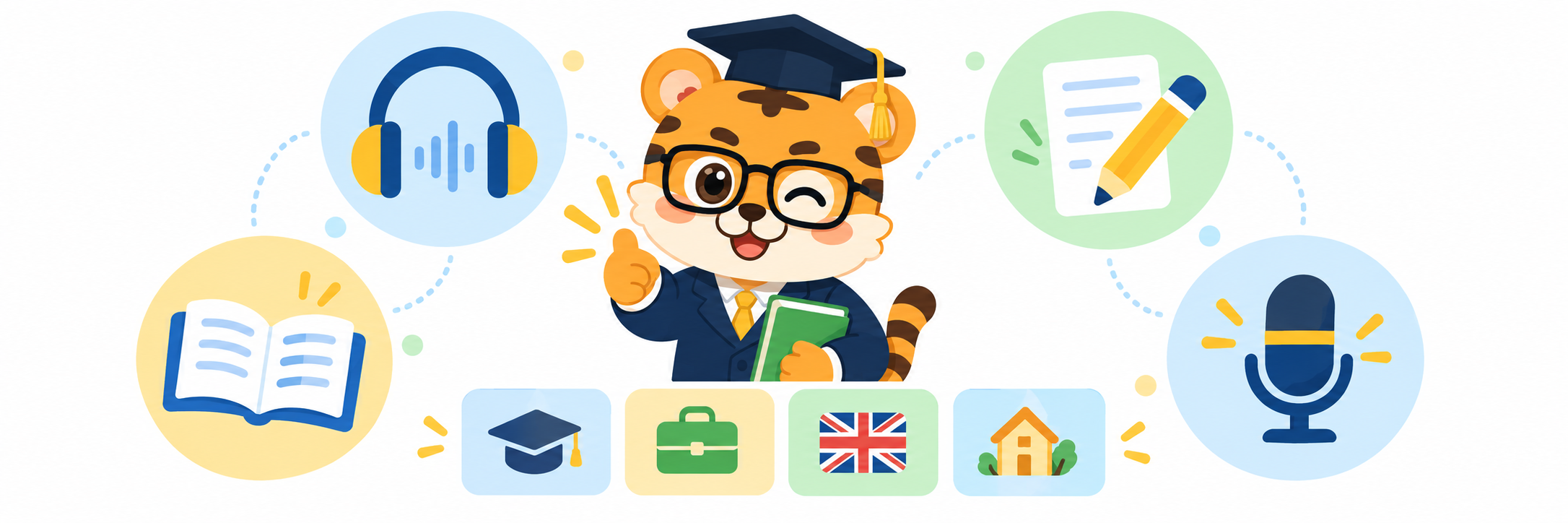
IELTS has four sections, Listening, Reading, Writing and Speaking. Listening, Reading and Writing are normally taken on the same day. Speaking may take place before or after the written components, depending on the test centre and schedule.
Listening tests whether you can follow spoken English and capture specific information as it moves past you. Names, numbers, addresses, corrections, signposting and paraphrases can all affect an answer. Reading is a test of comprehension, locating evidence and judging meaning. You do not need to translate every sentence to perform well, but you do need to understand what the question is asking and where the evidence sits.
Writing asks you to complete a written task under time limits. Academic and General Training use different Reading and Writing content, so the module you choose affects the material you practise. Speaking is a conversation with an examiner. It includes Part 1, Part 2 and Part 3, and it rewards clear communication rather than a speech that sounds memorised from beginning to end.
The IELTS version matters as well.
Academic IELTS is commonly used for higher education applications and some professional registration routes. General Training is often used for migration, work or practical everyday English contexts. IELTS for UKVI is a secure English language test version used for certain UK visa and immigration purposes. Life Skills tests only Listening and Speaking for specific UK visa routes, so it cannot replace a full four-skill result when an institution asks for one.
The names may look similar, but the use case can be different. A university applicant, a skilled worker applicant and a person applying for a particular family visa may all search for IELTS while needing different tests. Check the exact wording on the university, employer or visa page before booking.
Your score report normally shows four individual band scores and an Overall Band Score. Each skill is reported on the IELTS nine-band scale. The Overall score is calculated from the four skills and may be rounded according to the IELTS scoring rules. Since many institutions set both an overall requirement and minimum skill scores, do not plan around one number alone.
03 How to turn the full name into a study plan

Once you know what IELTS stands for, preparation becomes a set of practical decisions. Which version do you need, how far are you from the target, and how will you train each skill?
Start with the purpose of the test. Keep the relevant university, employer or immigration page open and write down the module, Overall score, minimum skill score and any date requirement. Requirements can change, so check the official test-centre or application page again when you book. A few minutes of checking can prevent weeks of preparation for the wrong module.
Then take a diagnostic practice session. For Listening and Reading, use a complete practice set and record accuracy, question types and time pressure. For Writing, check whether you answered the task fully and organised the response clearly. For Speaking, record yourself and listen for long pauses, repeated words and answers that drift away from the question. A diagnostic is not an official band score. It is a way to turn general anxiety into specific training problems.
After that, build a routine that matches the way the test works. Listening and Reading need question-type familiarity, vocabulary, spelling and fast evidence finding. Writing needs a repeatable process for understanding the task, planning, drafting and checking. Speaking needs practice with one-minute preparation, two-minute turns, follow-up questions and natural pauses. A timed full practice session each week can show whether your method still works when the clock is running.
If you want one place to connect practice, feedback and review, Youshow IELTS can work as an IELTS study workspace. It offers Listening and Reading practice organised around the Cambridge IELTS 8–20 question-bank structure, AI speaking simulations for Parts 1, 2 and 3, and computer-style Writing Task 1 and Task 2 practice with timing, word counts and AI writing feedback. It also includes focused practice such as intensive listening and shadowing, plus public tools such as a band calculator, speaking topic generator, mini mock tests and learning records. You can visit the official website at https://ielts.youshowedu.com.
One boundary is important. Platform feedback, estimated scores and mini mock results are practice support. They are not official IELTS scores and do not replace examiner assessment. The platform can help you keep practising, see patterns in your work and decide what to review next. Your final choice of test version and target score still needs to come from the relevant university, organisation or visa requirement.
So remember the full name, then move beyond the acronym. Confirm the purpose, choose the right version, split the work across four skills and use feedback to keep adjusting. A question that began as a definition can become a clear route to test day.
Thank you for reading. If this guide helped, feel free to share it with someone preparing for IELTS.
Continue this topic
Related reading and practice

Turn blog tips into your actual IELTS training flow
Don't just read tips. On the platform you can put speaking practice, real test drills and review into one steady prep rhythm.
- AI speaking mock practice
- Structured Cambridge IELTS practice
- Continue your personal prep rhythm after signing in
- Extend to writing feedback and question banks later