Is IELTS Equivalent to GCSE English? Key Differences for UK Applications [2026 Guide]
![Is IELTS Equivalent to GCSE English? Key Differences for UK Applications [2026 Guide]](/blog-covers/is-ielts-equivalent-to-gcse-english-2026/cover-en.png)
If you are applying for a UK course, you may be asked for GCSE English even though you already have an IELTS result. Both relate to English, so it is natural to wonder whether one can stand in for the other.
The short answer is that there is no universal official conversion from an IELTS band to a GCSE grade. A university, course, or visa rule may accept one of several forms of evidence for a particular English requirement, but that does not make the qualifications interchangeable in every context.
01 IELTS and GCSE English measure different things
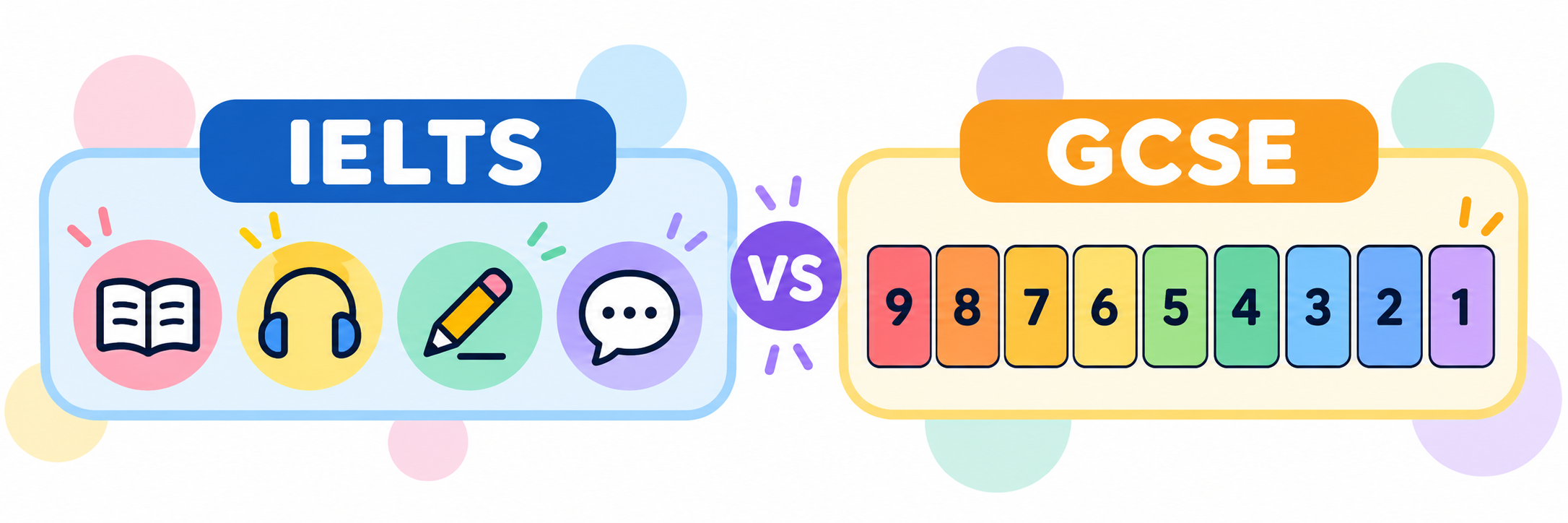
GCSE English is a subject qualification taken within the UK school system. In England, GCSEs commonly use grades 9 to 1, with 9 as the highest grade and grade 4 often described as a standard pass. Wales and Northern Ireland use different grading arrangements, so the qualification’s origin matters.
IELTS is an English language test. It assesses listening, reading, writing, and speaking and reports a band score from 0 to 9. It shows how a candidate performed in those test components; it is not a record of studying and passing the GCSE English curriculum.
Think of them as two different measuring tools. IELTS brings four language skills together in a test, while GCSE English is a school subject qualification. An IELTS 7.0 does not automatically become GCSE grade 7, and there is no single IELTS 6.5 that every institution treats as GCSE grade 4.
The Common European Framework of Reference for Languages, or CEFR, can make the comparison seem easier. IELTS research places the C1 threshold between bands 6.5 and 7, but that is a language proficiency reference. It does not create an official IELTS-to-GCSE grade table.
When a course page says it accepts an equivalent English qualification, it may mean that another credential can satisfy a specific entry requirement. It does not necessarily mean that two qualifications are identical or directly convertible.
02 Can IELTS replace GCSE English for university entry?

Sometimes, but it depends on what the course is asking you to prove. If the requirement is simply English language proficiency, the university may list accepted tests along with minimum overall and component scores. An IELTS result that meets those conditions may satisfy that language requirement.
GCSE English can also be an academic entry requirement. A course may ask applicants to have a particular GCSE English grade as part of their previous subject qualifications. In that case, a high IELTS score does not automatically replace a stated GCSE English grade 4, 5, or 6.
Read the course page as two separate questions. What GCSE English grade is required? What English language evidence is accepted for international applicants? If the page says IELTS can be used as an alternative, check the course’s own overall score, individual skill scores, test type, and result validity rules.
Some universities may waive an IELTS test for applicants whose previous study meets their English-language policy. That is an institutional decision. The course, level of study, and applicant’s background can all affect the answer, so a general university admissions page may not tell the whole story.
A practical way to check is to look for the exact phrases GCSE English requirement, English language requirement, and alternative qualifications. If the wording is unclear, email the admissions team with the course name and your results. A written answer from the university is much more useful than trying to infer equivalence from an unofficial score chart.
03 Check the exact rule for visas and other applications

UK visa rules may recognise GCSE English in specific circumstances, but that does not make GCSE and IELTS universally interchangeable for every visa. For one route to meeting the English language requirement under the Student route, the rules recognise a regulated GCSE English qualification (or certain other English qualifications) awarded after education at a UK-based school that began while the applicant was under 18. For degree-level study, a sponsoring institution may also be able to assess English under the rules.
Those routes have conditions. It is not safe to shorten them to “a GCSE means you do not need IELTS.” The exact qualification, course level, and the sponsor’s assessment method can matter. A work visa, professional registration, university course, or application to another country may follow a different policy.
Before submitting documents, check what you are applying for, whether the requirement refers to a GCSE English subject grade or evidence of language proficiency, the IELTS overall and component scores, accepted alternatives, and whether your test and results meet the stated conditions. A few minutes with the exact policy can prevent a lot of guesswork.
If you are preparing for IELTS, Youshow IELTS brings listening, reading, writing, and speaking practice together with speaking simulations, writing feedback, and study review. It also offers preparation tools such as a score calculator and study plans. Explore the English site at https://ielts.youshowedu.com/en.
IELTS and GCSE English can both support an application, but they answer different questions. Identify what the institution needs you to prove, then submit the evidence that matches that requirement.
That is the useful distinction to keep in mind when someone asks whether IELTS is equivalent to GCSE English.
Continue this topic
Related reading and practice

Turn blog tips into your actual IELTS training flow
Don't just read tips. On the platform you can put speaking practice, real test drills and review into one steady prep rhythm.
- AI speaking mock practice
- Structured Cambridge IELTS practice
- Continue your personal prep rhythm after signing in
- Extend to writing feedback and question banks later