Does IELTS Expire? The Two-Year Validity Rule Explained [2026 Guide]
![Does IELTS Expire? The Two-Year Validity Rule Explained [2026 Guide]](/blog-covers/does-ielts-expire-2026/cover-en.png)
Many people receive an IELTS result and then open a calendar instead of celebrating. They want to know one thing, does IELTS expire?
Yes, you should not treat an IELTS result as a permanently valid English certificate. IELTS recommends that results are considered valid for two years after the test has been taken. That is the common planning rule, but the university, visa office, employer or professional body receiving your result may use its own checking date.
So the useful answer is not only two years. You need to place your test date, application date and the organisation’s deadline on the same timeline.
01 IELTS expiry usually starts from the test date
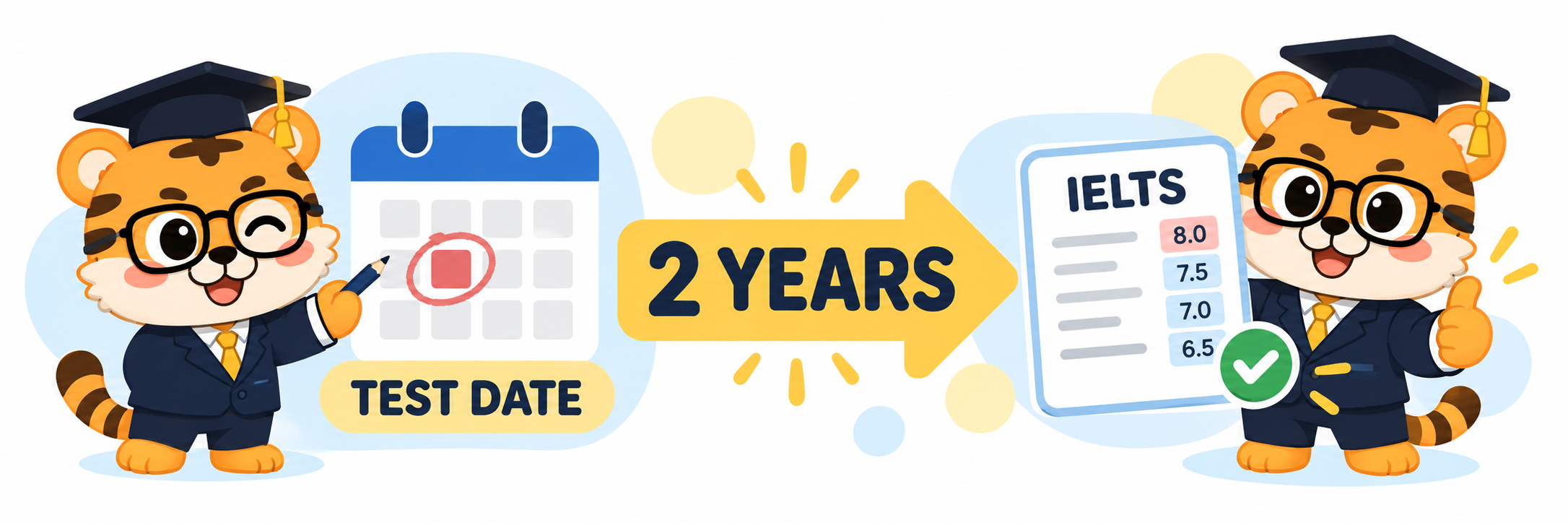
In the usual situation, the two-year period is counted from the date you took IELTS. It does not normally begin when your result is released, and downloading a digital Test Report Form does not create a fresh period.
If you took the test on 22 September 2026, many organisations would start by using 22 September 2028 as the two-year reference point. Your Test Report Form records the test date, so an organisation can use it when checking how old the result is. A result released several days later does not normally move the date forward.
The wording matters here. IELTS recommends that results are considered valid for two years because language ability can change over time. This is a strong planning rule, but it is not a single calendar promise for every application. A recognising organisation may choose to accept results for a longer period, or it may apply a stricter requirement.
An expired result does not vanish from the record. Your old score and test history still exist. The problem is that an organisation may no longer accept that result as current evidence for its process. Continuing to study English does not automatically turn an old score into a new one.
That is where the search question becomes practical. The issue is not whether the score report still exists. It is whether the organisation handling your application will accept it now.
02 The important question is which date the organisation checks

The same IELTS result can face different timing rules in different applications. A university may check whether the score is valid when you submit the application. It may also require the result to remain valid when you enrol or start the course. A visa or immigration process can include document requests, appointments and a decision date after the first submission. A professional registration body may have its own rule about how old a result can be.
That creates an uncomfortable situation. Your result may still be within the usual two-year period on the day you apply, but it could become too old by the time the next stage is assessed.
Instead of asking only how long IELTS lasts, check three things. What is my test date, which date does this organisation use, and which IELTS version does the application accept? Also record the Overall Band Score and every minimum skill score. A result can be recent enough and still fail because the test type or score combination is wrong.
If the official page is unclear, contact the admissions team, visa office or professional body. Include your test date, test type, planned submission date and result details in one message. Ask whether the current result can be used for that exact application, then save the written reply. A forum post about someone using a three-year-old result cannot confirm your own route.
One more distinction helps. An expired IELTS result does not say that your English has fallen to zero. It says that the result may no longer be accepted as recent evidence for a particular process. If the organisation asks for a new valid result, you will normally need to take the test again or check whether it accepts another approved form of English evidence. Any exception or extension belongs to the receiving organisation’s policy.
03 How to plan a retake when your result is close to expiry

If your result is only a few months away from the two-year point, do not book a new test before checking the timeline. Put the test date, result release date, application deadline, course start date and possible visa or registration decision date in one table. Mark the date that could pass the two-year point. The risk becomes much easier to see.
Then open the current language requirement page for your application. Check the accepted test version, Overall score, minimum component scores and validity wording. If the page only says that IELTS is accepted but does not explain the date, ask by email. It is a small and slightly boring action, but it can save you from paying an application fee and discovering that you need a new result.
If a retake is necessary, start with a timed diagnostic session. For Listening and Reading, record accuracy, locating speed and spelling errors. For Writing, check whether you fully answered the task. For Speaking, record Part 1, Part 2 and Part 3, then listen for long pauses, repeated words and answers that lose direction. This tells you whether the retake is only about validity or whether one skill also needs work.
If you want to connect practice and review in one IELTS workspace, Youshow IELTS can help. It offers Listening and Reading practice organised around the Cambridge IELTS 8–20 question-bank structure, AI speaking simulations and feedback for Parts 1, 2 and 3, plus computer-style Writing Task 1 and Task 2 practice with timing, word counts and AI writing feedback. Focused practice such as intensive listening and shadowing, along with a band calculator, speaking topic generator, mini mock tests and learning records, can help you see what to fix before a retake. The official website is https://ielts.youshowedu.com.
Platform feedback, estimated scores and mini mock results are practice support. They are not official IELTS scores and do not replace examiner assessment. Use the platform to decide what to practise next, while using the current requirements from your university, visa office or professional body for the final application decision.
So, does IELTS expire? In planning terms, yes, you should expect a two-year window from the test date. But you do not need to panic at the phrase two years. Write down the test date, confirm the organisation’s checking date, verify the test type and score requirements, then decide whether to submit or retake. Once the dates are visible, the worry becomes a plan.
Thank you for reading. If this guide helped, feel free to share it with someone preparing for IELTS.
Continue this topic
Related reading and practice

Turn blog tips into your actual IELTS training flow
Don't just read tips. On the platform you can put speaking practice, real test drills and review into one steady prep rhythm.
- AI speaking mock practice
- Structured Cambridge IELTS practice
- Continue your personal prep rhythm after signing in
- Extend to writing feedback and question banks later