IELTS Reading: Stop Getting Stuck on Unknown Words: Learn to Guess
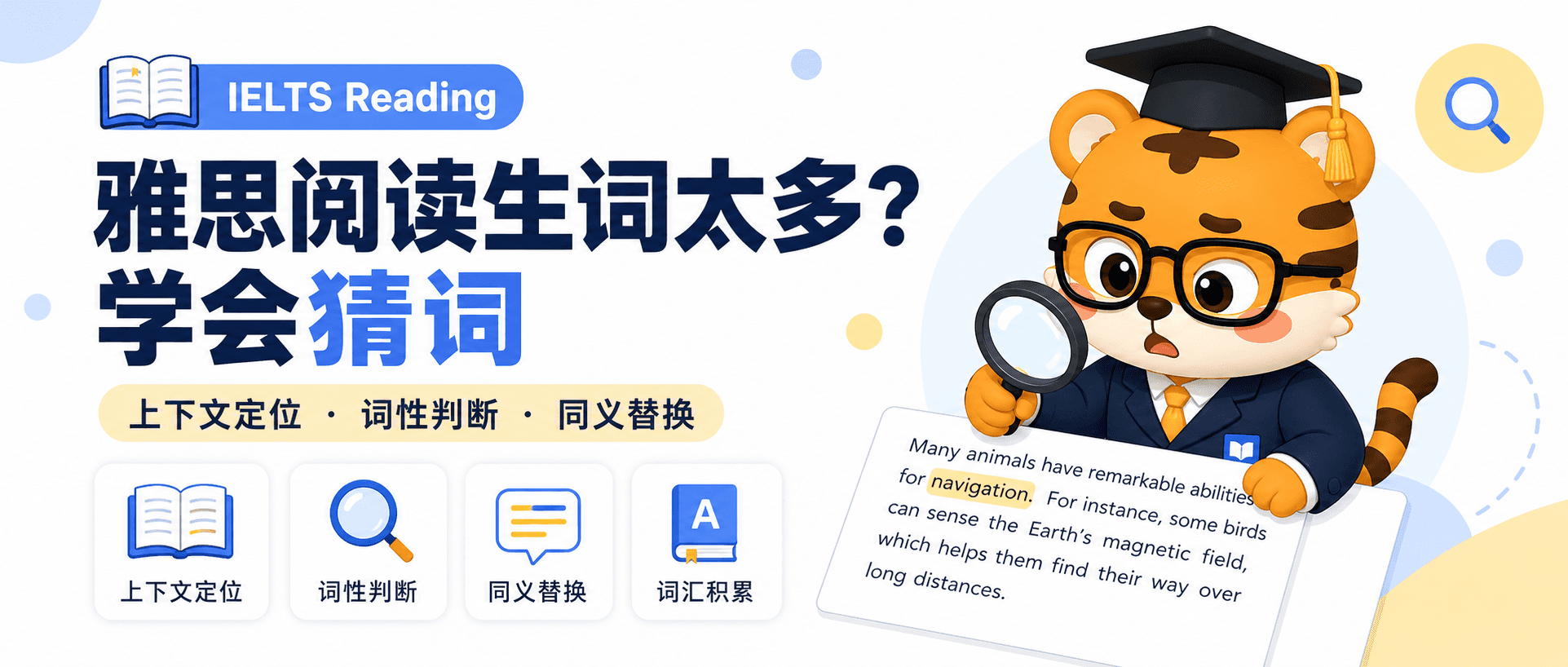
It is normal to encounter unfamiliar words in a set of IELTS Reading passages. The most frustrating thing is when an unknown word halts your progress—your eyes get stuck, and you stop reading the two lines that follow. By the time you finally figure it out, a lot of time has passed, and you might have even guessed the meaning of that sentence incorrectly.
With three passages and 40 questions, many tasks simply require locating the corresponding information. When you face too many unknown words, first judge whether they are relevant to the current question.
First, Check What the Word Does in the Sentence
When you come across an unknown word, do not reach for the dictionary first; instead, look at its part of speech. If there is "a" or "the" before the blank, it likely requires a noun; "be" verbs are often followed by adjectives; and "to" usually precedes verbs. Guessing the part of speech first immediately narrows down the answer range.
For example, in "The new system was ___ for small farms," the clues "was" and "for" suggest the blank is most likely an adjective. For sentence completion tasks, also watch the word count limit; if the requirement is ONE WORD, do not write two.
You must also observe singular and plural nouns. If you see "many," "several," or "a number of" before a noun, it usually needs a plural form. If "an" precedes the blank, the answer must start with a vowel sound. These subtle grammatical clues may seem minor, but they are crucial for scoring full marks in reading cloze tasks.
Context Clues: Sentences Before and After Are Often More Useful
A word taken out of context might have several meanings. Placing it back into a sentence and looking at the surrounding sentences often helps narrow down the definition.
When you see an unfamiliar word, first look for cause-and-effect, examples, and explanations within the same sentence. Words like because, therefore, for example, and in other words often provide explanations. Parentheses, dashes, and defining relative clauses can also help narrow down the meaning.
Pay special attention to contrastive words. If a previous sentence describes a method as cheap but "however" follows with an unfamiliar word, that word likely carries meanings like "troublesome," "limited," or "ineffective." You don't need the full dictionary definition; knowing whether the word aligns with or contradicts the previous text is sufficient for True/False/Not Given questions.
Synonym Replacement Asks You to Hunt for Answers Near Familiar Words
IELTS Reading rarely uses identical wording for questions and passages. If the question says "reduce costs," the original text might say "lower expenses"; if the question says "a rapid increase," the text might say "numbers rose sharply." When encountering an unknown word, grab onto the familiar words nearby and analyze whether the sentence is stating a cause, result, viewpoint, or time change.
In a question asking why a certain plan was adopted, the original text may not use "use" or "choose" but rather "was selected because." The "why" in the question corresponds to "because," and "adoption" corresponds to "selected." The unfamiliar word only occupies a small part of the sentence. Assemble the known relationships first to locate the answer much faster.
During practice, do not just copy out unknown words. Write the question sentence and the original sentence side-by-side from your mistakes, circle the parts where replacement occurred, and label the synonyms with their parts of speech. After reviewing five or six passages, you will realize the common replacements always revolve around a few specific sets, and your reading speed will stabilize.
Different Question Types Require Different Levels of Guessing
For True/False/Not Given questions and multiple-choice, you don't necessarily need to fully translate the word. Your main goal is to confirm if the original text and the question are synonymous, opposite, or unmentioned. Sentence completion is stricter; aside from meaning, you must check spelling, singular/plural forms, and word count.
When matching paragraph information, looking at the paragraph starts, ends, and repeated nouns is more useful than getting stuck on an adjective. Matching headings is the same; focus on what the entire paragraph repeatedly discusses rather than getting derailed by unfamiliar proper nouns.
Guessing Cannot Rely on Hunches; You Must Leave Evidence
During your regular training, when you meet an unknown word, write down a guess and then the evidence. For example, "might be negative because there is a 'but' and 'decline' later," or "should be equipment because there is 'install' before and 'repair' after."
After completing a set of reading passages, categorize unknown words into three types. The first is words you don't know but are irrelevant to the answers—mark them and move on. The second are words you can guess the general direction for using context—record the clues. The third are words that appear repeatedly and affect multiple questions—only then list them in your daily vocabulary review.
Don't copy dozens of pages into your vocabulary list at once. Pick about ten words a day, writing down the original sentence, part of speech, and synonyms. The next day, cover the Chinese translation and see if you can recall the general meaning from the original sentence.
Use Youshow IELTS for Quick Vocabulary Guessing Training
If you only have ten minutes a day, you can use Youshow IELTS for a short reading exercise. It includes question training, vocabulary review, and error checking. After finishing, specifically mark situations like "guessed the word correctly despite not knowing it" and "wrong answer caused by an unknown word." The first type builds confidence, while the second is suitable for re-examining the context.
The practice sessions on the Youshow IELTS app are easy to split up; you can do a set during your commute and review errors in the evening. You can search for it in the Apple App Store or visit the official website https://ielts.youshowedu.com. Listening, speaking, writing, and reading can all be incorporated into the same study plan so you don't have to hunt for materials every day.
When your IELTS Reading score is stagnant, vocabulary needs to be supplemented, but you must learn to keep moving forward during the actual exam. First check the part of speech, then the relationship between words, and finally the required precision based on the question type. You don't need to know every word in the article. Deal with the words that will affect your answers first, so the entire passage isn't held back by a single difficult term.
Continue this topic
Related reading and practice

Turn blog tips into your actual IELTS training flow
Don't just read tips. On the platform you can put speaking practice, real test drills and review into one steady prep rhythm.
- AI speaking mock practice
- Structured Cambridge IELTS practice
- Continue your personal prep rhythm after signing in
- Extend to writing feedback and question banks later