How to Avoid Empty Writing in IELTS Task 2: Analyze the Root Cause Before Proposing Solutions
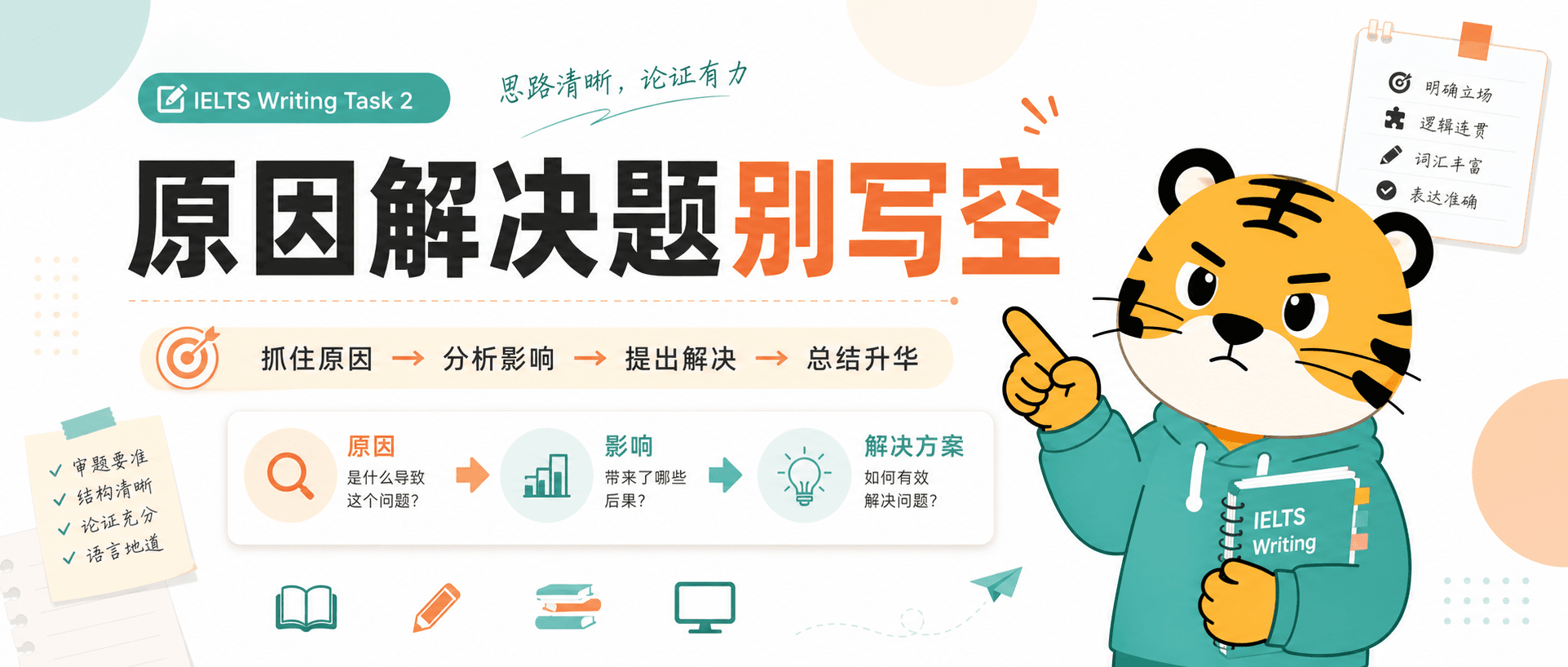
In IELTS Writing Task 2, "Cause and Solution" questions can be incredibly frustrating.
It’s not that you don’t know how to write them; it’s that they easily drift into fluff. You might ramble about "rapid social development" and "increased stress" at the beginning, then tack on a few lines about "the government should take responsibility" or "individuals should try harder." It looks like you’ve hit the word count, but reading it back, it feels like you’ve gone nowhere real.
For this check, I looked up open pages from July 2026 on the IDP IELTS Writing site, the official mock exam entry on the BC Chinese website, and BC’s prep resources. The message was consistent: Task 2 is for responding to problems, statements, or social issues; minimum 250 words; usually reserved for around 40 minutes in the 60-minute slot; and you should read the task clearly before starting.
So, this post deals with one thing: How to actually answer these questions instead of just filling space.
Separate the Prompt's Actions to Avoid a Mental Block
The trickiest part of these questions is that they often ask you to do two things: explain why this is happening and explain how to solve it.
If you just stare at the general topic—like traffic, obesity, or screen addiction—your brain grabs素材 instantly, but you miss the tasks the prompt is actually demanding. If you don't separate them at the start, it’s easy to mix causes and advice into a single paragraph.
Now, I write a very simple phrase in the margin to prevent this: "Dig a pit in the first paragraph, patch it in the second."
Avoid Fluff by Not Turning Causes into Generic Backgrounds
Many people's problem with the cause paragraph isn't a lack of content, but that it's too broad.
For example, if the topic is about teenagers sitting still, starting with "rapid social development" is something anyone could say. A much more stable approach is to dig one layer deeper: explain why this is happening specifically to this group.
Instead of "environmental changes," writing about how "homework and tutoring eat into activity time" or "phones consume rest time" feels much more concrete. It’s also easier to follow logically, so you won't drift off track immediately.
Specific Solutions Are More Important Than Sounding "Correct"
I used to write sentences like "government should take measures" or "people should pay more attention." They look correct, but they are empty.
In cause and solution questions, the biggest danger is writing slogans. You should force yourself to add two things: who is doing it? and how will it work?
For instance, don't just write schools should encourage exercise. Instead, write that schools implement mandatory two extracurricular sports sessions a week, or reduce purely online homework for younger students. This turns abstract advice into an actionable plan.
Match Causes and Solutions One-to-One, Don't Just Ramble Separately
Many essays look complete on the surface, but feel scattered because the causes written in the first half aren't actually solved in the second half.
If your first point is "short videos are too addictive," your solution section should prioritize platform time-limits or parents enforcing phone retrieval. If your cause is "school schedules are overloaded," your solution should explain how schools can reallocate time for activities. When you anchor your solutions to your specific causes, the essay flows better and looks genuinely responsive to the prompt.
Don't Be Greedy. Two Points per Paragraph Are Enough
These questions have a trap: they encourage too much. Writing three reasons and three solutions might look impressive, but they will be superficial.
A safer strategy is usually to put two points in the cause paragraph and two corresponding solutions in the solution paragraph. Expanding two specific points is far more useful than stacking four empty points.
Use Smaller, Concrete Examples to Kill the Fluff
I’ve developed a simple method: stop dragging the whole "society" into your examples. The more grandiose you try to be, the emptier it becomes.
For example, when talking about university students under pressure, you don't necessarily have to drag in the entire employment market. Writing about how "'deadlines all cram into one week'" or "'part-time jobs eat up sleep time'" works much better. Small, concrete scenes are your best tool to ground your writing.
Drill Analysis and Matching, Don't Just Grind Full Essays
If you find yourself writing empty causes and solutions recently, I genuinely don't recommend forcing yourself to write full essays every day. It’s too easy to fall into the same repetitive trap.
Short drills are better: choose three questions a day, just analyze the task; write two specific causes for each; then assign a solution to each; finally, check if they match one-to-one.
If you want to keep your task analysis and practices organized in one place—so you don't have to flip through apps—try Youshow IELTS. You can download it on the Apple App Store or visit the official homepage at [https://ielts.youshowedu.com/en]. Even though the name says PTE, it’s perfect for these kinds of fragmented IELTS practice drills.
Mastering This Question Will Stop You from Using Buzzy Words
I think the real threshold for this question isn't your ability to memorize formal expressions; it's whether you've executed these steps: dissect the prompt, don't write empty causes, kill the slogans, and actually fill the holes you dug.
Once you get these steps right, your writing will feel significantly heavier and more real. Cause and solution questions often aren't a matter of not knowing what to think, but of thinking too broadly and ending up with fluffy ideas. Flatten them out first, and your score will be much more stable.

Continue this topic
Related reading and practice

Turn blog tips into your actual IELTS training flow
Don't just read tips. On the platform you can put speaking practice, real test drills and review into one steady prep rhythm.
- AI speaking mock practice
- Structured Cambridge IELTS practice
- Continue your personal prep rhythm after signing in
- Extend to writing feedback and question banks later