What is IELTS exam? A Simple Guide to the Four Sections and Scores
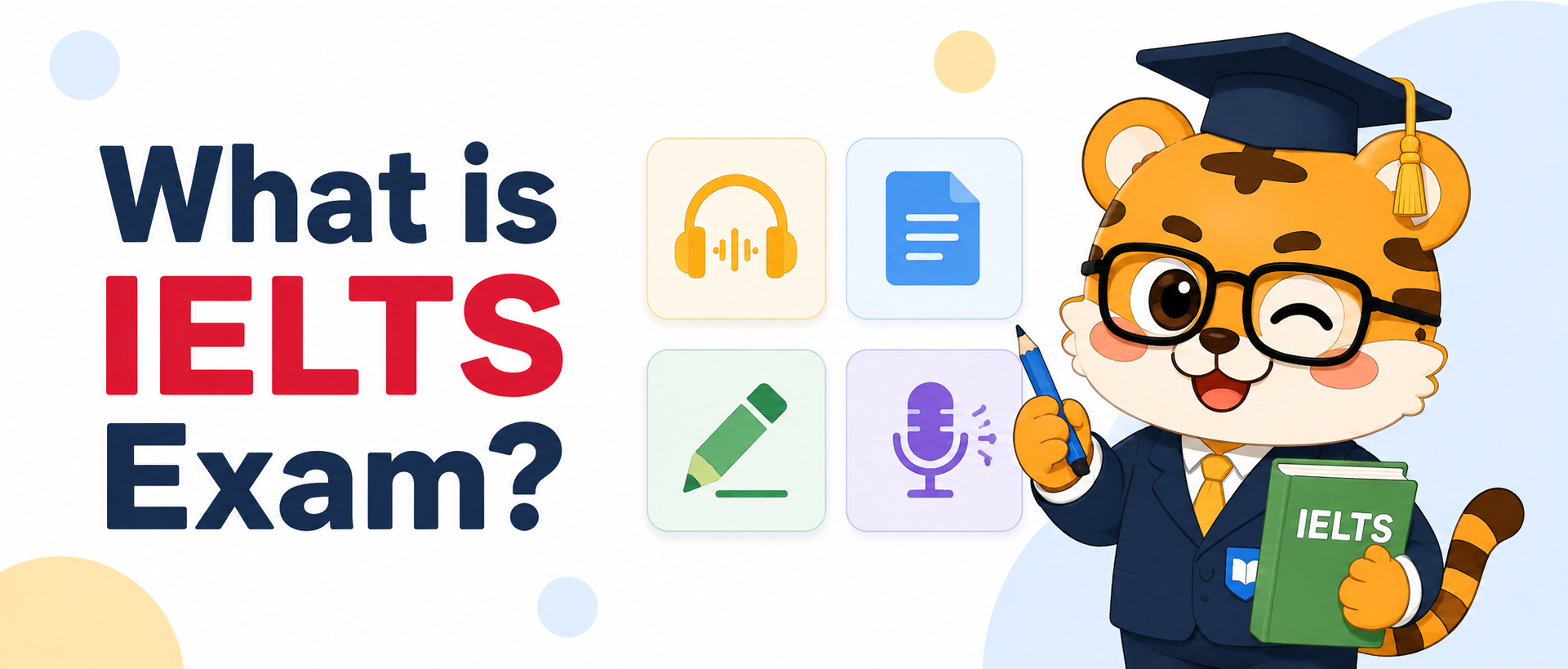
IELTS is a test of practical English ability
IELTS means the International English Language Testing System. It checks how well you can listen, read, write, and speak in English. Universities, employers, immigration offices, and professional organisations may ask for an IELTS result. Their requirements are not all the same, so you should check the exact test type and score before booking.
When people search what is IELTS exam, they often want a very simple answer. It is an English test, but it is not only a vocabulary or grammar quiz. You listen to conversations and talks, read longer texts, write two tasks, and speak with an examiner. Your overall result comes from these four sections.
Listening checks attention as well as understanding
The Listening test has 40 questions in four parts. You may hear a daily conversation, a talk in an education setting, or a discussion between several people. The recording is played once. You need to follow the meaning, notice changes in the conversation, and write answers with the correct spelling, ending, and number of words.
This is why a student can understand the general idea and still lose marks. A missing plural ending or a spelling mistake can change the answer. During practice, do not only check whether you heard the word. Check why you missed it and whether you wrote it in the form the question allowed.
Reading tests speed, meaning, and paraphrase
Reading has 40 questions. Academic Reading usually contains texts about education, science, society, or other wider topics. General Training Reading includes notices, workplace information, advertisements, and longer everyday texts. Both versions can include matching, multiple choice, sentence completion, and information questions.
The answer is often not written in exactly the same words as the question. You need to find a useful location in the passage, read the surrounding lines, and understand the paraphrase. Reading every sentence slowly from the beginning can use too much time. A better practice habit is to learn how question words connect with the writer’s words.
Writing has two tasks with different jobs
Writing has Task 1 and Task 2. In Academic IELTS, Task 1 is usually a chart, process, or map. In General Training, Task 1 is a letter. Task 2 is an essay in both versions and usually has more influence on the Writing score.
Many candidates spend too long on the first task and then rush the essay. A short plan can protect your time. Decide what the question is asking, choose the main points, and leave time to check missing words, grammar, and paragraph order. A complicated word does not help if the sentence is unclear.
Speaking is a short conversation with an examiner
The Speaking test has three parts. Part 1 covers familiar topics such as your home, work, studies, or free time. In Part 2, you receive a topic card and some preparation time before speaking for longer. Part 3 discusses the topic in a more general and deeper way.
The examiner considers fluency, vocabulary, grammar, and pronunciation. You do not need to sound like a television presenter. If you make a small mistake, correct it when needed and continue. A clear answer with a reason and a small example is usually more useful than a memorised speech that does not fit the question.
Academic, General Training, and UKVI have different uses
Academic IELTS is commonly used for university and postgraduate applications. General Training is often used for migration, work, or non-degree training. Listening and Speaking are similar, but Reading and Writing have different tasks. Always check the page of the university, employer, or immigration authority before you book.
IELTS for UKVI is used for certain UK visa and immigration purposes. IELTS Life Skills is another option for specific situations and mainly checks Speaking and Listening. The names can look similar on a booking page, but choosing the wrong test can cause problems later. The organisation receiving your result should decide which version you need.
IELTS scores use a nine-band scale
Each skill receives a band score from 0 to 9. Your overall band is calculated from the four skill scores and may end in a half band. An overall 6.5 does not mean that every section is 6.5. A university may ask for an overall score and a minimum score in every skill, so read both parts of the requirement.
The bands describe different levels of control and communication. Around Band 5, a candidate may manage familiar communication but still make frequent errors. Around Band 6 or 7, ideas and understanding are usually more stable, although problems can remain. Higher bands require stronger control of detail, accuracy, and complex language. Your target should come from the requirement you need to meet.
Check three things before booking
First, check where you will use the result. A school, visa office, employer, or professional body may set different rules. Second, check the delivery format and date. Computer-delivered IELTS requires keyboard typing, while paper-based IELTS requires handwriting, and the Speaking test may be on another day. Third, check the current rules about score validity, One Skill Retake, combining results, or accepted alternatives.
Before you start serious preparation, take a full practice test. Record the exact problem: spelling in Listening, locating evidence in Reading, unfinished ideas in Writing, or long pauses in Speaking. “My English is bad” does not tell you what to do next. A short error log does.
A simple preparation routine is enough to begin
Too many resources can make IELTS preparation feel heavy. Choose one regular place for practice, review, and progress tracking. YoushowIELTS offers practice for Listening, Reading, Writing, and Speaking, along with results that can help you see which skill needs attention. You can find the official website at https://ielts.youshowedu.com.
Start with a small weekly routine: two focused Listening sessions, one Writing Task 2, and three short Speaking recordings. Reviewing the reason for each mistake is more useful than collecting a large number of unfinished exercises. Once you understand the four sections and the score requirement, the test becomes much easier to plan for.
IELTS is a four-skill English test taken under time limits. Its difficulty comes from managing information, answers, and timing at the same time. Learn which test type you need, understand the job of each section, and measure your weak points before you book. That gives your preparation a clear starting point.
Continue this topic
Related reading and practice

Turn blog tips into your actual IELTS training flow
Don't just read tips. On the platform you can put speaking practice, real test drills and review into one steady prep rhythm.
- AI speaking mock practice
- Structured Cambridge IELTS practice
- Continue your personal prep rhythm after signing in
- Extend to writing feedback and question banks later