What is IELTS? A Simple Guide to the IELTS Exam, Skills, and Scores
If you are looking at studying, working, or moving abroad, you have probably seen the word IELTS. IELTS means the International English Language Testing System. Many people see it as one huge and scary English paper. Then they hear someone talk about a band 7 or 8 and feel even more nervous.
IELTS is easier to understand than it first looks. It checks whether you can use English in real study and daily communication. You listen, read, write, and speak. It is not only a grammar test, so a person who is good at grammar exercises may still feel confused in the first IELTS practice test.
IELTS uses one overall score to describe your English
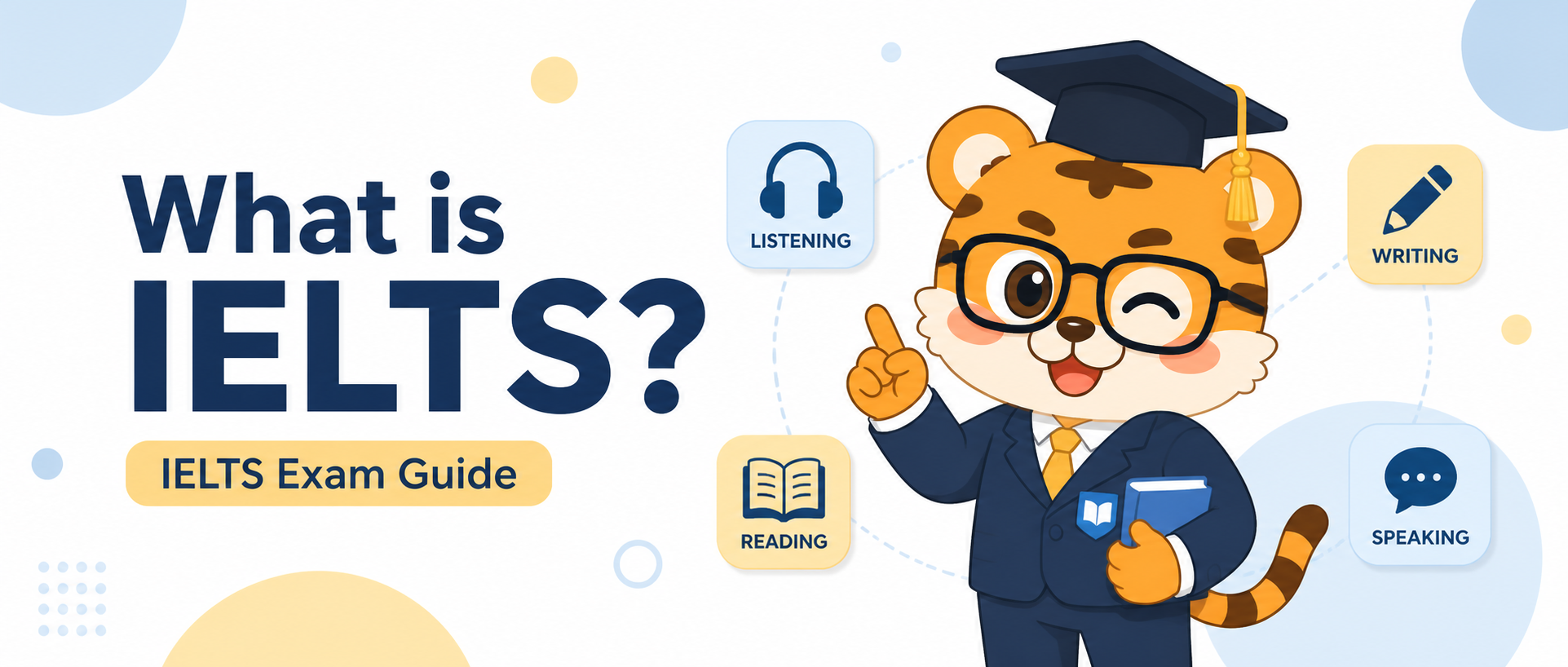
There are four parts: Listening, Reading, Writing, and Speaking. Listening and Speaking usually involve daily or study communication. Reading and Writing change a little depending on the test type.
Each section receives a band score from 0 to 9. You also get an Overall band score. For example, if your scores are 7 in Listening, 6.5 in Reading, 6 in Writing, and 6.5 in Speaking, your average is 6.5, so your Overall score is 6.5. The score report still shows every section because a school or visa organisation may require a minimum score in each skill.
IELTS is not marked like a school exam with a percentage. A band 6 usually means you can handle familiar English tasks, while band 7 shows more stable use in many situations. Bands 8 and 9 require stronger accuracy, vocabulary, and understanding speed. Check the section requirements before you only focus on the Overall score.
Academic and General Training serve different purposes
The two common versions are IELTS Academic and IELTS General Training. Academic is usually used for university or postgraduate applications and some professional registration. Its Reading texts are more academic. Writing Task 1 normally includes a chart, process, or map, and Task 2 is an essay.
General Training is often used for migration, work, or non-degree training. Its Reading materials are closer to notices, advertisements, workplace documents, and general articles. Writing Task 1 is usually a letter. Both versions have four skills, but the Reading and Writing papers are not interchangeable.
Before booking, read the exact requirement from your school, employer, or visa authority. A page that simply says “IELTS required” may not tell you the whole story. Some UK visa applications require IELTS for UKVI. The accepted test type, location, and score should all be checked before you pay.
The four skills need different kinds of practice
The Listening recording plays once, and answers often follow the order of the recording. You need meaning, spelling, plurals, and numbers. Reading has a fixed time limit and many paraphrases, so finding one similar word is not enough. In Writing, you need to answer every part of the task and connect your ideas, explanations, and examples.
Speaking is a face-to-face conversation with an examiner. Part 1 covers familiar life topics. Part 2 asks you to speak for one to two minutes from a cue card. Part 3 becomes more abstract. You do not need to sound like a news presenter. A short pause or a different way of saying something is fine. Answers that stay too short or use one memorised template for everything usually cause bigger problems.
Take a full practice test before planning every study day
Many beginners collect lots of books and apps before they know their weak points. Try one full Listening and Reading test, record a Part 2 answer, and write a Task 2 essay. This may not give you a perfect official prediction, but it can show whether your problem is vocabulary, timing, spelling, or answer development.
If your Listening mistakes are mostly numbers and spelling, practise those parts. If Reading mistakes come from poor locating, work on paraphrases and paragraph meaning. Keep your own Writing and Speaking answers so you can review them after a few days. A small, clear correction is more useful than changing resources every week.
YoushowIELTS/优秀雅思 can also be a daily practice option. The official website is https://ielts.youshowedu.com. It brings Listening, Speaking, Reading, and Writing practice together with error review and study records. It can be useful when you study in short sessions: learn the question type, find your common mistakes, and practise those mistakes again.
IELTS results show your English level around the test period
IELTS scores are used for study, work, migration, and professional registration, but every organisation sets its own rules. Many organisations treat an IELTS result as valid for two years, yet the final decision belongs to the organisation receiving your application.
In simple words, IELTS is an exam that evaluates communication through Listening, Speaking, Reading, and Writing. Once you know which version you need and what score is required, preparation becomes a list of specific practice tasks instead of one large worry.
Continue this topic
Related reading and practice

Turn blog tips into your actual IELTS training flow
Don't just read tips. On the platform you can put speaking practice, real test drills and review into one steady prep rhythm.
- AI speaking mock practice
- Structured Cambridge IELTS practice
- Continue your personal prep rhythm after signing in
- Extend to writing feedback and question banks later