Is PTE Better Than IELTS? Compare Acceptance, Format and Test Fit [2026 Guide]
![Is PTE Better Than IELTS? Compare Acceptance, Format and Test Fit [2026 Guide]](/blog-covers/is-pte-better-than-ielts-2026/cover-en.png)
I was reviewing the official IELTS and PTE test descriptions today, and one thing stood out. When people ask whether PTE is better than IELTS, they are rarely asking about a test in the abstract. They are asking whether one choice can save them time, money and a painful detour before an application deadline.
That concern is completely reasonable. The problem is that the strengths of these tests sit in different places. PTE is not automatically better for everyone. It may be a better fit for a particular application goal and a particular way of handling exam pressure.
01 Check the application before checking the internet ranking

IELTS Academic and PTE Academic both assess listening, reading, speaking and writing, but the result you need to submit is more important than the name of the exam. Universities, employers, professional bodies and visa routes can accept different test versions, and they may set different overall and component-score requirements.
IELTS has a broad recognition network, with an official organisation search that lets candidates check by country and organisation type. PTE Academic is also accepted by many universities and institutions, and Pearson lists study, work and migration uses across destinations including Australia, Canada, the United Kingdom and New Zealand. Still, acceptance of PTE Academic does not automatically mean acceptance of PTE Academic UKVI. A test version can be the small detail that controls the whole decision.
This is the boring first step, and it is worth doing. Open the official page for your university, visa route or professional registration and write down the full test name, accepted version, overall score and minimum score for each skill. Do not record only a number such as IELTS 7 or PTE 65. Words such as Academic, General Training and UKVI may matter more than the number.
If you are applying for a degree in the UK, IELTS Academic is a familiar option, while PTE Academic may also be accepted by your institution. Check the current university page instead of relying on a friend’s memory. If your route requires a UK Secure English Language Test, you may need PTE Academic UKVI or IELTS for UKVI. Booking the wrong version can turn weeks of preparation into a very expensive warm-up.
If the score cannot be used for the application, it does not matter whether PTE feels faster or IELTS feels more natural. Check the destination first, then compare the tests.
02 PTE offers structure, while IELTS offers live interaction

PTE Academic is a computer-based test of about two hours, organised into Speaking and Writing, Reading, and Listening. Speaking is recorded through a microphone rather than delivered as a face-to-face interview. The official question types include Read Aloud, Repeat Sentence, Describe Image and Retell Lecture, with newer tasks such as Summarize Group Discussion and Respond to a Situation.
This can suit candidates who dislike a live interview and feel comfortable with a headset, screen and countdown. The timing, task shape and recording window become familiar after repeated practice. You do not have to guess what an examiner will ask next. You can focus on understanding the prompt, capturing the key information and starting on time.
Predictable does not mean easy. PTE moves the pressure into reaction speed, one-take recording and linked tasks. A long pause, a repeated attempt or an answer that runs out of time can damage a response before the idea is complete. Some integrated tasks also contribute to more than one skill, so a break in your listening or note-taking can affect the next part of the chain.
IELTS Academic Speaking is an 11–14 minute interaction with an examiner. Part 1 uses familiar topics, Part 2 gives you one minute to prepare before a longer turn, and Part 3 moves towards reasons, effects, comparisons and wider trends. Candidates who are comfortable responding to another person and developing an answer may find this format closer to their normal use of English.
Live interaction has its own pressure. You cannot delete a sentence and record it again. You cannot wait until the perfect grammar arrives before you speak. A memorised answer may sound fine for a familiar prompt, then fall apart when a follow-up question takes the conversation somewhere else.
Writing creates another split. IELTS Academic Writing has Task 1 and Task 2. Task 1 deals with a graph, table, chart, process or map, while Task 2 responds to a point of view, argument or problem. Task coverage and time allocation matter. PTE Writing sits inside the integrated Speaking and Writing part, with tasks such as Summarize Written Text and a 200–300 word essay. Switching between formats can become part of the difficulty.
My own view is simple. PTE’s structure helps only if you are willing to accept fixed task types and strict timing. IELTS’s interaction feels natural only if you are willing to handle a real examiner and open-ended development. Do not ask which test looks more modern or more conversational. Ask which kind of pressure you can practise until it becomes stable.
03 Take one serious practice session for each test
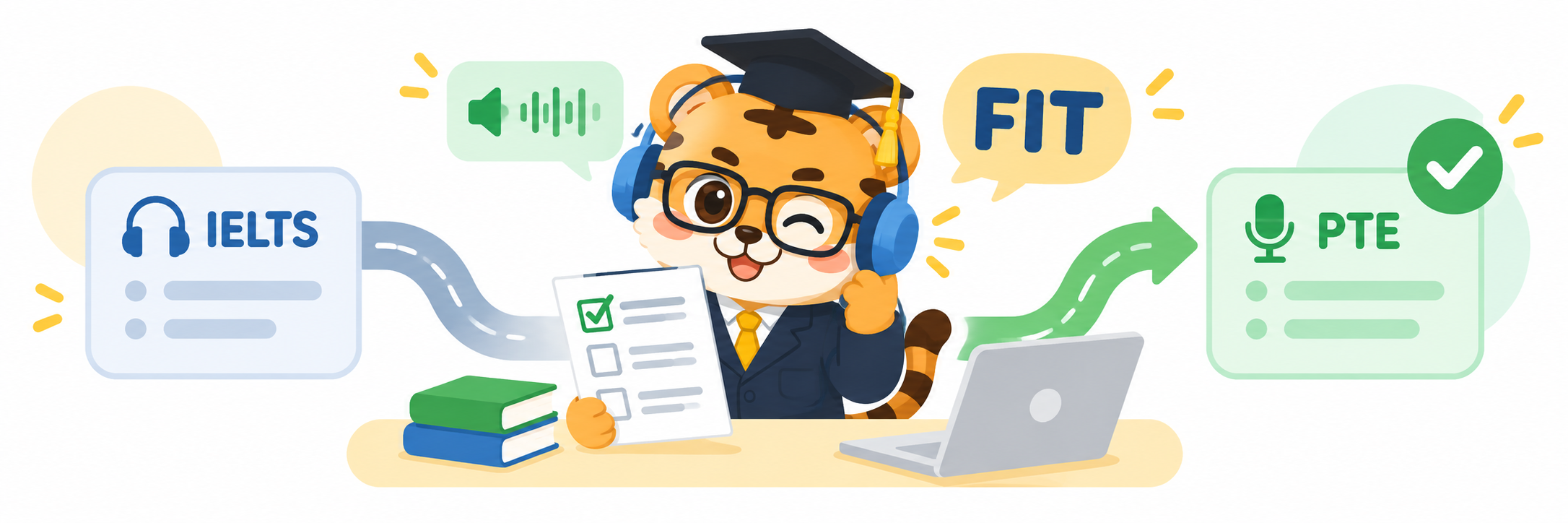
People sometimes say PTE is better for candidates with weaker English because the question types can be broken into drills. There is some truth in that, but it can also send you in the wrong direction. A fixed format can help you build a routine, but it cannot replace listening comprehension, vocabulary, grammar or clear communication.
Other people prefer IELTS because the Speaking test feels more like real communication and the score is familiar in many destinations. That can be a sensible reason, but you still need to complete two Writing tasks in 60 minutes and develop ideas in Speaking Part 3. A few polished sentences will not carry the whole test.
Do not decide from a label. Complete one official sample set or serious timed practice session for each test. Record four things, your completion time, the question types that caused the most errors, whether each skill reached your target range, and whether the fatigue came from English or from an unfamiliar interface. Record your speaking as well. Listen to a PTE response, and record an IELTS Part 2 answer followed by a few follow-up questions. Memory is a poor scoring system.
If the microphone countdown makes you lose control but you can keep developing an answer with another person, IELTS is worth trying first. If an examiner’s attention makes you freeze but you can read, remember, respond and record under a short timer, PTE may feel more manageable. More manageable is not the same as guaranteed to produce a higher score.
If you choose IELTS, Youshow IELTS can sit in the daily practice and review part of your plan. The platform brings Listening, Reading, Writing and Speaking into one study workspace. It offers practice organised around the Cambridge IELTS 8–20 question-bank structure, AI Speaking simulations and feedback for Parts 1, 2 and 3, and computer-style Writing Task 1 and Task 2 practice with timing, word counts and AI writing feedback. It also includes intensive listening, shadowing, a band calculator, a speaking topic generator and learning records. The official website is https://ielts.youshowedu.com.
Platform feedback, estimated scores and mini mock results are practice support. They are not official IELTS scores and do not replace examiner assessment. The useful change is that vague anxiety can become a specific task, such as I am not bad at IELTS, I need to extend Part 3 answers, or I do not hate PTE, my listening-and-recall chain keeps breaking in Repeat Sentence.
So, is PTE better than IELTS? There is no permanent winner on a general difficulty chart. Check the application requirements, identify whether you handle computer timing or live interaction better, and then verify the choice with two serious practice sessions.
There is no shortcut that takes the test for you. There is a better-matched route, and then there is the daily work of making that route steadier.
Thank you for reading. If this guide helped, feel free to share it with someone choosing between PTE and IELTS.
Continue this topic
Related reading and practice

Turn blog tips into your actual IELTS training flow
Don't just read tips. On the platform you can put speaking practice, real test drills and review into one steady prep rhythm.
- AI speaking mock practice
- Structured Cambridge IELTS practice
- Continue your personal prep rhythm after signing in
- Extend to writing feedback and question banks later