IELTS Speaking Public Transport: Give Specific Answers [Examples]
![IELTS Speaking Public Transport: Give Specific Answers [Examples]](/blog-covers/ielts-speaking-public-transport-answers-2026/cover-en.png)
You hear, “Do you often use public transport?” and your mind offers one word: bus. You say, “Yes, I take the bus,” and stop. The examiner is still looking at you, and you are already wondering what else there is to say.
There is no need to memorise a long list of transport vocabulary. These questions are usually about how you get around, why you choose a particular option and what the journey is like. A small, familiar detail can give your answer a clear shape.
IELTS describes Speaking Part 1 as a 4–5 minute conversation about familiar topics and everyday experiences. Public transport is one possible subject; the useful skill is responding clearly and adding relevant information without forcing a prepared speech into the conversation.
01 Start with a Direct Answer and a Real Routine

For “Do you often use public transport?”, answer directly, then add a routine or situation. “Yes, I take the bus to work most weekdays” gives the listener a clear response, a time and a purpose. It sounds more complete than a stand-alone yes.
If you rarely use it, say so. “Not very often. I usually walk because my office is close to home.” There is no need to pretend that you love buses. Living nearby, having an inconvenient route or cycling most days can all be honest answers.
Keep three kinds of detail in mind: when you travel, where you usually go and why you choose that option. You do not need all three in every answer. Pick one or two that fit naturally. “I take the metro when I need to cross the city because it is more predictable during rush hour” gives a situation and a reason.
Another likely question is “What kind of public transport do you use most?” If your answer is the subway or bus, add one small detail: whether the route is familiar, whether the stop is nearby or how long the journey takes. “I use the subway most because there is a station near my flat, and it takes about twenty minutes to get to the city centre.” Nothing dramatic is required; the detail simply helps the listener picture the journey.
Here is a useful check: a longer answer is only better when each extra sentence makes the picture clearer. Stop when the detail no longer answers the question. Part 1 is a conversation about familiar topics, not a two-minute monologue about your commute.
02 Explain Preferences Through Everyday Reasons
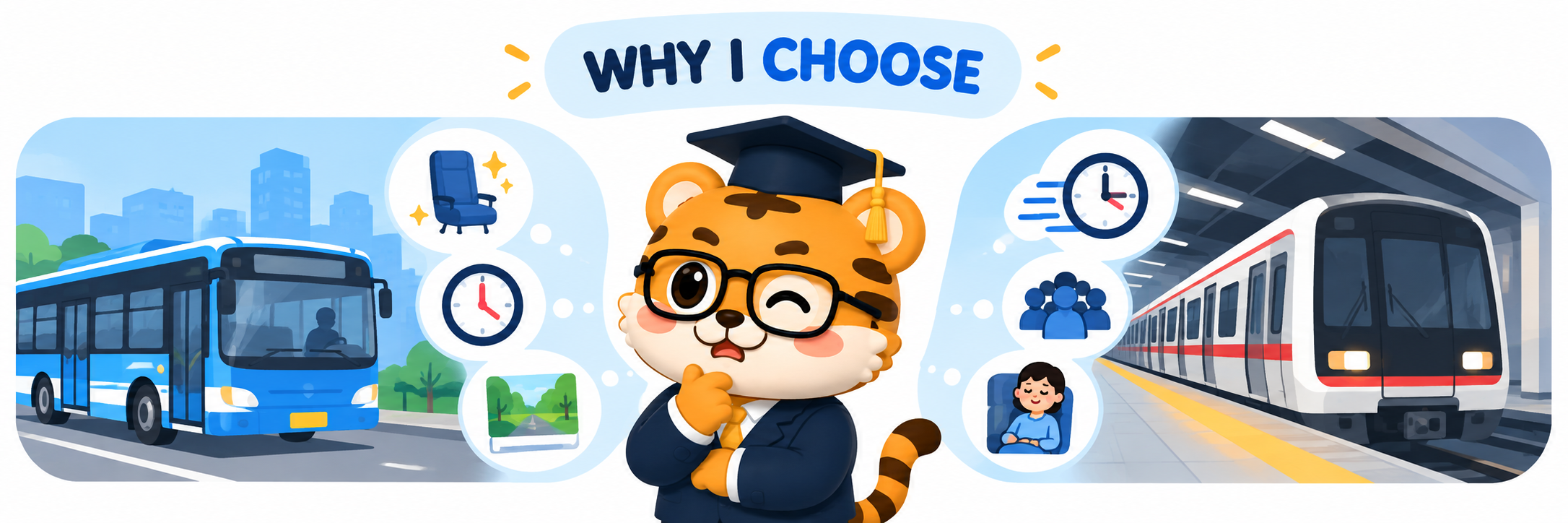
“Do you like travelling by public transport?” can lead to “I like it because it is convenient.” That is a valid start, but what makes it convenient? Perhaps you do not have to look for parking, you can read on the way or you avoid driving in rush-hour traffic. One concrete reason turns a generic adjective into a personal answer.
Try a light pattern: opinion, one reason and a small result. “I do, especially when I go downtown. I don’t have to worry about parking, so the trip feels less stressful.” You do not need to draft an essay in your first language and translate every line, or squeeze in words such as fancy, comfortable and environmentally friendly just to sound advanced.
Disliking public transport works just as well. “Not really. The bus can get crowded in the evening, and I sometimes have to wait quite a while.” That explains the feeling. If it is true for you, add a qualification: “I still take it when parking is difficult.” This describes a real choice instead of trying to defend a perfect position.
What if you have little experience with buses? Do not invent a commute. Start with what you know: “I don’t use buses much where I live, so I usually get around by bike.” The question is about your own situation. An honest answer is easier to explain and gives you a natural response if the examiner asks a follow-up.
The useful practice is not memorising ten synonyms. It is connecting a reason to its result. After “convenient,” say what it saves you from doing. After “crowded,” explain how that affects the trip. After “cheap,” say why the cost matters to you. One familiar word with an accurate everyday detail often says more than a string of impressive vocabulary.
03 Practise Follow-Ups Instead of Memorising a Script

Public transport is easy to practise in a short set. Record an answer to “Do you often use public transport?”, then try “How do you usually travel to work or school?” and “What do you like or dislike about it?” The questions share a subject, but each one asks you to focus on something slightly different.
The first asks about frequency, the second about your usual option and the third about your opinion. You can use the same subway route for all three answers, but change the point you make each time. That is more useful than repeating one memorised paragraph when the wording changes in the test.
Listen to your recording twice. On the first pass, check whether you answered the question. On the second, notice if the answer is too short, if you repeat the same word or if pauses break up your meaning. Change one detail to make it clearer, then record it again. It may feel awkward at first, especially when you hear your own voice, but short rounds of practice make it easier to spot a specific habit than collecting a page of transport vocabulary.
If you want to keep speaking practice and feedback in one place, Youshow IELTS (优秀雅思) offers AI speaking simulations for Parts 1–3 with feedback after practice, alongside listening, reading, writing and review tools. You can use a public transport prompt for a short response, then listen again to see whether your point is clear and developed. Visit the Youshow IELTS website. Platform feedback supports practice; it is not an official IELTS result or examiner score.
Think back to that first moment when all you could think of was “bus.” You do not need a speech about urban transport. Say how you travel, give one reason and add a real detail. Bus, subway or walking can all work; what matters is that the answer sounds like your own life.
That’s all for now. If you found this useful, feel free to leave a like.
Thanks for reading. See you next time.
Continue this topic
Related reading and practice

Turn blog tips into your actual IELTS training flow
Don't just read tips. On the platform you can put speaking practice, real test drills and review into one steady prep rhythm.
- AI speaking mock practice
- Structured Cambridge IELTS practice
- Continue your personal prep rhythm after signing in
- Extend to writing feedback and question banks later