IELTS True/False/Not Given: False vs Not Given [2026 Guide]
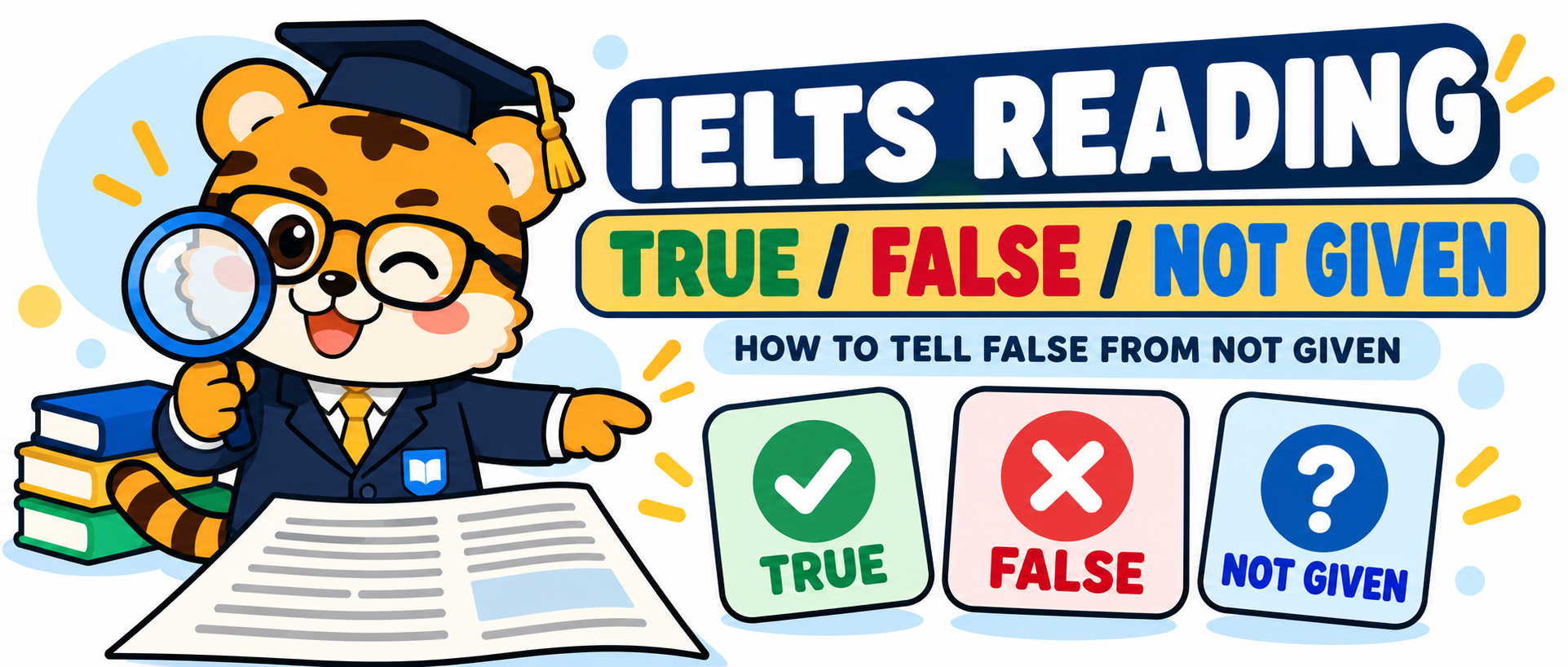
The hardest part of an IELTS Reading True/False/Not Given question is often the space between False and Not Given. You spot a familiar word in the passage, but that does not automatically make the statement True. The task is to compare the complete statement with the information in the text.
The official IELTS guide draws a useful line. False means the statement contradicts information in the passage, while Not Given means the passage neither supports nor contradicts it. That sounds simple until outside knowledge, assumptions, and partial matches start crowding in. Here is a three-step way to keep your decision tied to the evidence.
01 Break the statement into its parts

Many wrong answers begin before you have finished reading the statement. Your eye catches a familiar noun, you scan for the same word in the passage, and it feels as if the answer should be obvious. But you need to match the full claim: who did what, to whom, and under which time or conditions.
Try this invented practice statement. 'All visitors must book in advance.' Mark the subject, visitors, then the scope word all, and then the claim must book in advance. When you return to the passage, look for evidence that covers each of those parts. A sentence saying that some visitors booked a tour is not enough to confirm that everyone has to book ahead.
The difference is small on the page and large in the answer. The passage may describe what a few people chose to do, while the statement turns that choice into a requirement for everyone. Expose every part of the statement before you search for its evidence.
You can make a quick note beside the question: subject, action, object, scope, time. You do not need to translate the whole sentence and then reason from your translation. A compact breakdown keeps the exact claim in view and makes paraphrases easier to recognise.
02 False needs a contradiction; Not Given needs missing information

Keep 'I did not find it' separate from 'I found the opposite.' False is not a feeling that the statement seems unlikely; it requires information in the passage that conflicts with the statement. If the statement says every visitor must book, and the passage clearly says visitors can enter without booking, the two claims contradict each other.
Suppose the passage only explains how to book a tour. It does not say whether every visitor must book or whether walk-ins are accepted. You cannot upgrade that gap to False. The passage has left a key part unanswered, so the statement is Not Given. Even if you know that many venues require reservations, your real-world knowledge cannot fill the passage's silence.
Scope words are common traps. When a statement uses all, only, always, never, the first, or the most, a passage that says some, often, or one option may not support the stronger claim. That still does not automatically make the answer False. Look for an explicit counterexample; if there is one, you have a contradiction. If the text simply does not settle the claim, choose Not Given.
Time and comparison work the same way. A statement says a method is currently the most popular, but the passage only describes its past use. A statement compares the price of A and B, but the passage gives only the price of A. A missing piece points to Not Given; an explicit opposite points to False.
03 Make a short evidence chain before you choose

For each question, make a small evidence chain by asking what the core claim is, which sentence is relevant, and whether the subject, scope, and conditions match. Then choose an answer. This may feel slow at first, especially in timed practice. It is still useful to get the reasoning right before you gradually shorten the process.
Return to the invented example. The passage says, 'Visitors can book a tour online or ask at the desk about spaces available that day.' The statement says, 'All visitors must book in advance.' The passage does not say that everyone has to book, and it does not say that visitors cannot ask at the desk. The statement adds all and must, so this evidence neither confirms nor directly rejects it. The best answer is Not Given, even though the passage contains the word book.
Now change the passage to 'Visitors do not need a reservation and can join the tour directly.' That directly conflicts with must book in advance, so the answer becomes False. The deciding evidence is not the shared topic of booking. It is the clear reversal between must book and do not need a reservation.
When you review a mistake, do more than copy the correct option. Write one short reason. I treated some as all, confused missing information with a contradiction, or used outside knowledge to fill a gap. After a few rounds, a pattern often appears. You can work on that recurring trap instead of repeating an entire passage without knowing what went wrong.
If you want to include these questions in a broader IELTS routine, Youshow IELTS offers listening and reading practice arranged around Cambridge IELTS question structures, answer checking and review, plus learning records to help organise your next practice session. The platform is at https://ielts.youshowedu.com.
When you return to a question, do not ask whether the statement sounds plausible in real life. Ask whether the passage states it, or clearly says the opposite. A line of evidence you can point to is more reliable than a familiar keyword that caught your eye.
That is the whole distinction in one habit: find the claim, find the evidence, and leave any unanswered part unanswered.
Continue this topic
Related reading and practice

Turn blog tips into your actual IELTS training flow
Don't just read tips. On the platform you can put speaking practice, real test drills and review into one steady prep rhythm.
- AI speaking mock practice
- Structured Cambridge IELTS practice
- Continue your personal prep rhythm after signing in
- Extend to writing feedback and question banks later