How long IELTS is valid
IELTS validity usually starts from the test date
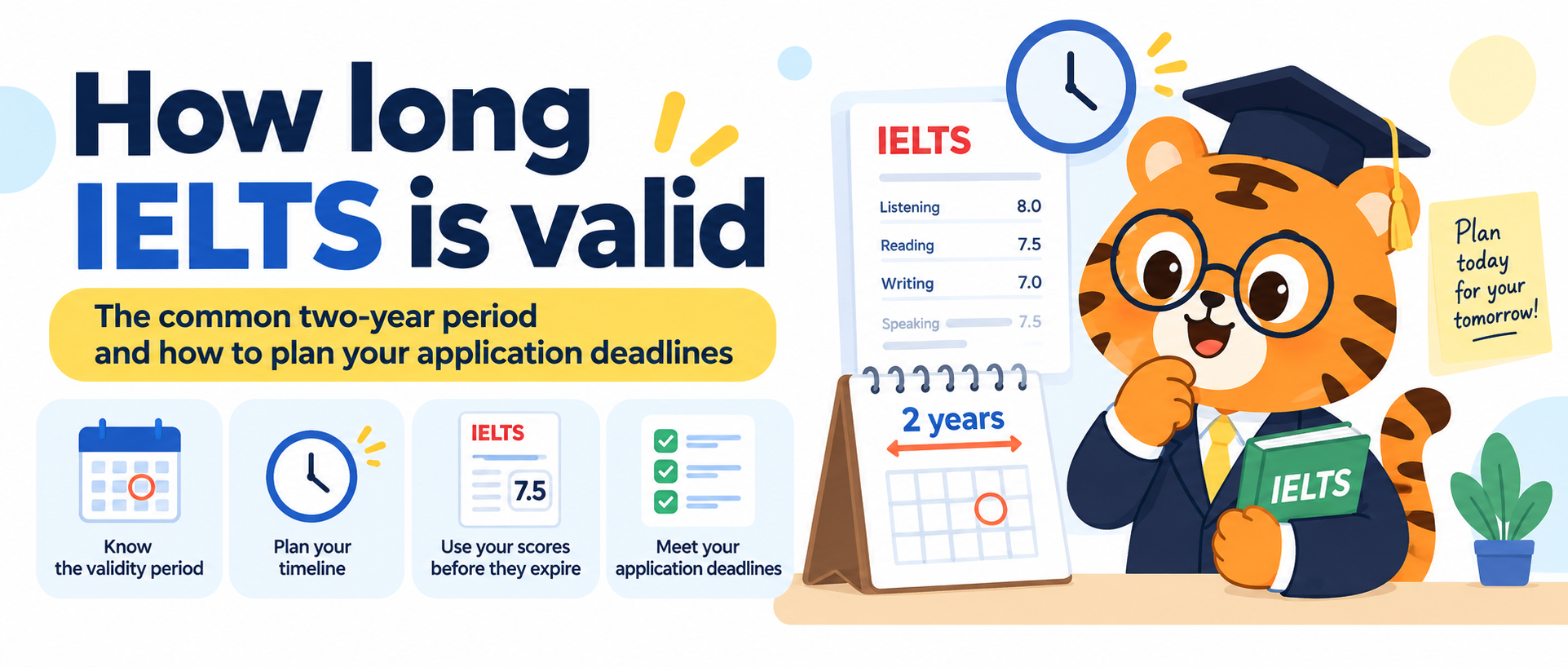
Many people search how long IELTS is valid when they have a score report but are not sure if they can still use it. In the common situation, an IELTS result is considered valid for two years from the test date. If you took the test on 10 September 2026, many organisations will look at 10 September 2028 as the usual end point. The clock does not start again when your result is released. A late result does not normally add extra days to the validity period.
This two-year period is a useful starting point, but it is not a promise for every application. Universities, employers, immigration offices, and professional bodies can set their own rules. Some check the date when you submit the application. Others want the result to remain valid when your course starts or when a visa decision is made. Find out which date matters before you plan around the score.
Different organisations may use different deadlines
A university may accept a score that is valid on the application date, while another university may also require it to be valid when you enrol. Visa and professional registration applications may have separate English-language rules. A result can be acceptable today and become a problem several months later if the next stage happens after the two-year period.
Open the latest language requirement page from the organisation you are applying to. Look for information about IELTS, score validity, test type, and document deadlines. If the page is unclear, email the admissions team, visa office, or registration body. Include your test date, IELTS type, and planned application date in the question. Save the reply so you have a clear record later.
An old score does not extend itself after two years
When an IELTS result passes its usual validity period, the score does not become a new current result just because you kept studying English. You cannot change the date on the report or present the old result as if you had taken a new test. If a new valid result is required, you will usually need to sit the test again.
Some organisations may review an older result together with evidence of continued study or work in English. That is an individual policy from the receiving organisation. It does not mean that IELTS itself has extended the score. A story from an online forum is not enough proof for your own application. Ask the exact organisation and keep its answer.
Plan backwards from the final application date
Write down the university deadline, visa submission date, course start date, and the latest date you can enrol. Then allow time for your test result, electronic score delivery, a possible change of test date, and a retake. Booking a test only a few days before a deadline leaves almost no room for a delay or a score that misses one band requirement. Remember that the speaking test may be scheduled on a different day.
If your current result is close to its end date, first ask which date the organisation uses. Being valid on the day you submit a form may not be enough if the next stage happens much later. If you decide to retake the test, leave enough time for writing and speaking practice. A rushed booking is not always the cheapest choice.
Check the test type and band requirements too
A score can be within its validity period and still be unsuitable for an application. A university may ask for IELTS Academic. Some work, visa, or immigration routes may require General Training or IELTS for UKVI. An organisation may also require an overall 7.0 with no band below 6.5. Check the test type, overall band, individual bands, and date together.
Do not assume that an old score and a new score can always be combined. Some organisations accept One Skill Retake, superscoring, or another English test, while others do not. Save the exact wording of the requirement before you book anything. This small check can prevent an expensive test that the organisation will not accept.
Use recent practice to decide whether a retake makes sense
When a score is nearly out of date, it is easy to panic and book the first available date. A better check is to practise for one week. Do several listening and reading sets, record two speaking answers, and write a full Task 2 essay. Look for repeated problems such as spelling, locating evidence, long pauses, or weak task response. One lucky mock-test score is not enough to describe your real level.
YoushowIELTS can help you practise and review all four IELTS skills. You can use the results to decide which area needs more work before choosing a test date. The official website is https://ielts.youshowedu.com. A short record of your recent practice is often more useful than guessing from an old score report.
Put the important dates in one simple table
Before submitting your documents, place the test date, validity end date, application deadline, and course start date together. Write down different deadlines for different schools or departments. Also check whether you need electronic score delivery, a particular test format, or a specific IELTS version. Once those details match, you can submit or book a retake with a clearer reason.
IELTS is commonly valid for two years from the test date, but the receiving organisation decides whether your result is acceptable for its process. Checking the dates early makes the application calmer and gives you time to retake the test for a real reason, not just because the report looks old.
Continue this topic
Related reading and practice

Turn blog tips into your actual IELTS training flow
Don't just read tips. On the platform you can put speaking practice, real test drills and review into one steady prep rhythm.
- AI speaking mock practice
- Structured Cambridge IELTS practice
- Continue your personal prep rhythm after signing in
- Extend to writing feedback and question banks later