How to Self-Study for IELTS: 4 Stages to Build a Study Plan
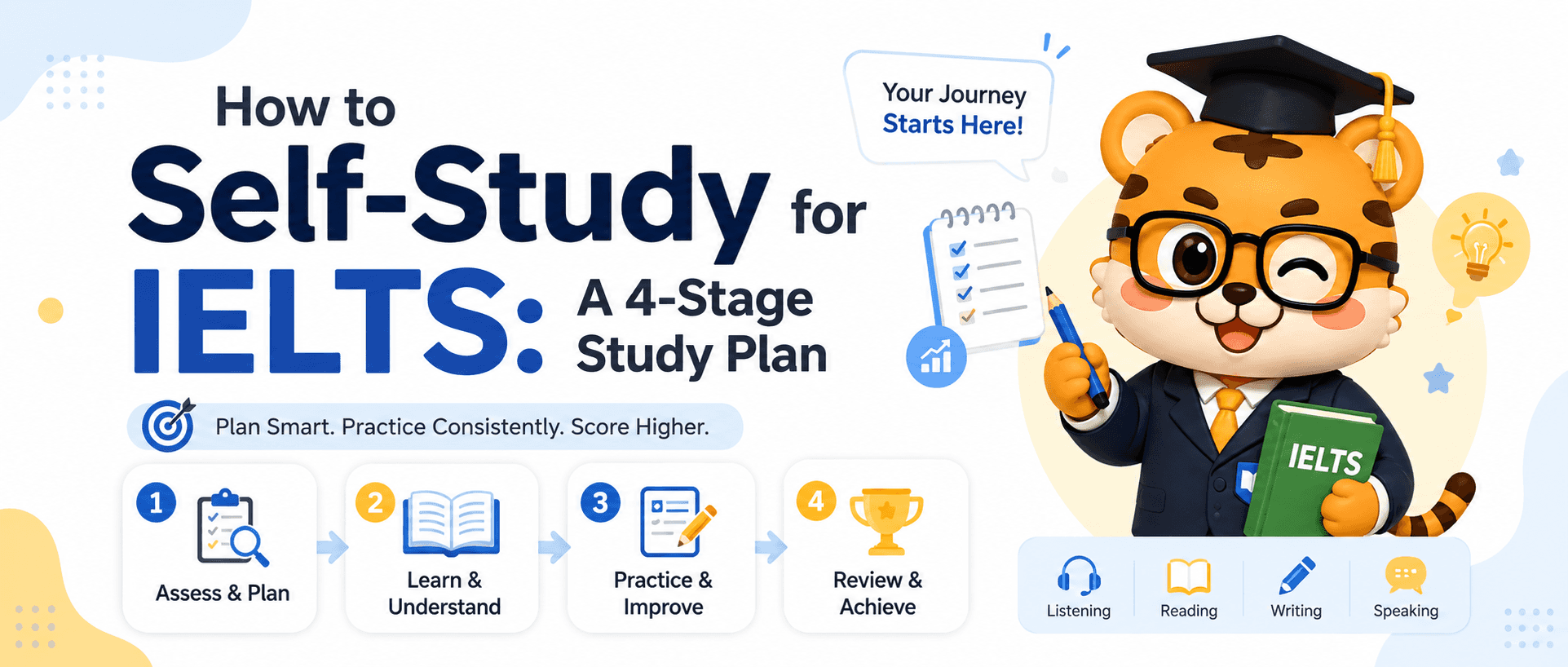
If you've been searching for IELTS self-study guides lately, the chances are high that you aren't looking for a bunch of empty platitudes about how "perseverance will get you across." Instead, you likely want to know the more practical truth:
Can you really increase your IELTS score through self-study, and how do you study effectively without wasting time?
The answer is yes, but only on the premise that you clarify your preparation order and training methods from the very beginning.
Many self-study failures aren't due to a lack of effort, but because they went off-track from the start:
- Grueling question drills without establishing methods first
- Memorizing a vast number of words but not using them in speaking, listening, reading, or writing
- Only inputting for writing and speaking (reading/writing) without outputting, leading to "appearing to know when relaxing, but failing in the exam room"
- Lacking reviews and repeating the same mistakes over and over
Therefore, this article won't just talk about principles. I will directly provide a more executable IELTS self-study roadmap for you.
I. Who is IELTS self-study suitable for?
Let's state the conclusion first: not everyone is suited for completely "naked" self-study (learning without guidance), but most test-takers fit the "self-study dominant, supported by a small amount of high-quality instruction" model.
If you meet the following criteria, self-study is typically feasible:
- Your English foundation isn't zero; you have at least a high school to university level base
- You can stably allocate time for studying every week
- You are willing to review your mistakes rather than just chasing question quantity
- You can accept slow initial score improvement, but expect a more stable performance once the method is "activated"
If your foundation is particularly weak, or if you have repeatedly taken the test and been stuck at the same score level, it is not recommended to completely self-study in isolation. Usually, the problem isn't "insufficient practice," but rather a deviation in your direction of study.
II. The first step for IELTS self-study isn't question drilling; it's setting goals and timelines
Many people immediately ask, "How many hours should I study per day?" This question itself is not accurate enough.
A more rational order is to determine first:
- What is your target total score?
- What are the minimum requirements for each individual subject?
- How many weeks are left until the exam?
- Where exactly is your current real level?
For example, strategies for targets below would be completely different:
| Scenario | Suggested Strategy |
|---|---|
| Target 6.5, overall foundation is average | Master question types and methods first, then steadily drill questions |
| Target 7+ where no single subject is a weak link | Strengthen "output" and timed training |
| Total score requirement isn't high, but writing/speaking must pass the pass line | Allocate resources towards weak subjects |
| Only 4 to 6 weeks left | Abandon "complete reconstruction"; prioritize parts that improve quickly |
If your goals are unclear, it is easy to fall into a state of "fake effort": studying every day, but not knowing if what you are learning actually serves the goal score.
III. The most stable IELTS self-study order: Vocab + Question Types + Output + Mock Exams
I recommend breaking self-study down into four stages rather than trying to handle everything at once (grasping both beard and eyebrows).
1. Stage 1: Fill in core vocabulary and basic expressions
This step isn't about rote memorizing incredibly difficult words, but solving the problem of not understanding high-frequency input materials first.
What is most worth accumulating during self-study:
- High-frequency scene words for Listening and Reading
- Common topic words for Writing Task 2
- Natural expressions used in Speaking, rather than formal written terms
The focus shouldn't be on how much you memorize, but on whether you can:
- Recognize them when seeing them
- React when hearing them
- Use them in your Writing and Speaking
2. Stage 2: Establish methods by question type
IELTS is not just a pure language test; it is a clear test of question types.
For example:
- Reading: You must distinguish the logic of True/False/NG, Matching, and Fill-in-the-blanks questions.
- Listening: You need to be familiar with signal words for Map questions, Choice questions, and Fill-in-the-blanks.
- Writing: You need to build structure frameworks for Task 1 and Task 2 separately.
- Speaking: You need different output strategies for Part 1, Part 2, and Part 3.
If question type methods are not established, the more questions you grind, the more prone you are to getting used to doing things incorrectly.
3. Stage 3: Start extensive output
This is the step that many self-study candidates overlook the most.
Grinding practice for Reading and Listening may give you a feeling of "having studied a lot," but what truly determines whether you pass is usually the quality of your output in Writing and Speaking.
It is suggested to start fixed tasks from this stage:
- Write 2 to 3 essays per week and seriously correct your mistakes.
- Record 3 to 5 Speaking answers per week and listen to yourself to identify problems.
Studying without outputting typically results in scores getting stuck halfway.
4. Stage 4: Timed mock exams and identifying gaps
In the later stages, the preparation focus should shift from "learning new content" to "stable performance."
The most important thing in this stage isn't piling up more materials, but seeing if you exist:
- Dropping off in the second half of Listening
- Being unable to finish the last section of Reading
- Losing control over time allocation in Writing
- Giving answers that are too short in Speaking or lacking expansion.
Improving scores later depends more on rhythm management and error control.
IV. How to arrange self-study for the four sections
1. Listening: Intensive listening first, then timed drills
A common self-study mistake for Listening is doing whole test papers without reviewing.
A more effective way is:
- Finish a set or a single section first.
- After checking answers, listen to the wrongly answered section again.
- Identify if the issue was not hearing it, hearing it but failing to react, or a spelling error.
- Organize high-frequency error words and signal expressions separately.
To stabilize your Listening score, reviewing is more important than simply grinding volume.
2. Reading: Don't blindly read through; learn to locate
IELTS Reading doesn't test your ability to do a full text close reading word-for-word; it tests your ability to quickly find key information relevant to the question.
When self-studying, focus on practicing:
- Extracting keywords from the question stem
- Identifying synonym replacements
- Locating paragraph information
- Controlling rhythm when switching question types
If you chew on the text linearly for every article, you will likely be both slow and messy.
3. Writing: Learn structure first, then pursue vocabulary upgrades
A common self-study mistake for Writing is pursuing "advanced expressions" too early.
What usually affects the score, however, are these more basic issues:
- Not directly responding to the topic
- Shallow expansion of paragraphs
- Lack of specific examples
- Repeated grammar errors
- Being unable to complete the essay in 40 minutes
So the correct order for improving Writing scores is usually:
- Learn to analyze the topic (scanning)
- Build paragraph structure
- Improve the completeness of argumentation
- Finally, optimize vocabulary and sentence structures.
4. Speaking: Don't memorize scripts; practice expandable frameworks
When self-studying Speaking, many people rely heavily on templates. However, the key to a high score isn't the template itself, but your ability to continue naturally.
A better approach for Speaking training:
- Part 1: Practice concise, natural extensions of 2 to 3 sentences.
- Part 2: Practice making a 1-minute keyword list and a 2-minute speaking structure.
- Part 3: Practice small arguments with the structure of Opinion + Reason + Example.
If you recite full paragraphs of scripts, you will crash quickly if interrupted or if the topic changes on exam day.
V. How many hours should I study per day for self-study?
There is no uniform answer, but most candidates can refer to the following range:
| Preparation Stage | Suggested Daily Duration |
|---|---|
| Long-term regular prep | 2 to 3 hours |
| Sprint phase | 3 to 5 hours |
| Working students or full-time students | 1.5 to 2 hours on weekdays, extended time on weekends |
More important than total duration is structure.
A more stable daily arrangement is usually:
- 40 minutes for vocabulary or input review
- 60 minutes for intensive training in the main subjects
- 30 to 60 minutes for output or mistake sorting
If you study for a very long time every day without reviewing or outputting, the results are usually worse than short-period, high-quality training.
VI. The 5 most common pitfalls of self-study
1. Finding more materials but finishing very few
Material anxiety is a high-frequency issue in IELTS self-study. You don't need a dozen methods books; you only need a system that can be executed continuously.
2. Only doing the subject you are good at
Many people like to grind Reading all the time because it brings a sense of achievement; however, what often drags down the total score is usually Writing and Speaking.
3. Only looking at answers without summarizing the cause of mistakes
If you don't know if your mistake is due to locating the wrong place, misunderstanding the meaning, vocabulary issues, or time allocation, you will likely make the same mistake next time.
4. Practicing Speaking and Writing too little
If these two subjects lack stable output, your performance on game day will fluctuate significantly.
5. Waiting too long to do mock exams
Many candidates wait until the week before the exam to do their first full timed test, only to find that the biggest problem is rhythm, not the knowledge itself.
VII. How to choose materials to improve self-study efficiency
Self-study isn't about having more materials being better; materials should form a synergy.
A more reasonable combination is:
- A relatively stable vocabulary accumulation material
- Practice resources for past papers that can be repeated
- Content for explaining methods and structural issues
Youshow IELTS offers content that emphasizes question type breakdown, training paths, and self-study efficiency. It is especially worth looking at for those who don't know how to arrange the order of four subjects or how to diagnose score stagnation. It can be more helpful than simply grinding through more practice questions. You can find it at https://ielts.youshowedu.com/en.
VIII. An IELTS Self-Study Plan You Can Follow Directly
If you don't have a clear rhythm yet, you can use this basic version:
- Weeks 1-2: Test your level, fill in core vocabulary, and get familiar with the question types of all four subjects.
- Weeks 3-5: Specialized training for Listening and Reading; start fixed output for Writing and Speaking.
- Weeks 6-8: Increase timed training and focus on correcting weak points.
- Last 2 weeks: Complete mock exams, stabilize rhythm, and reduce ineffective volume addition.
Remember one principle when implementing this:
Practice is not about finishing more questions, but about reducing future repetition of mistakes.
IX. Conclusion
The core of a truly effective IELTS self-study guide isn't "grinding hard every day," but rather:
- Setting goals and timelines first
- Establishing methods by question type next
- Starting Writing and Speaking output as early as possible
- Stabilizing your score through review and mock exams
If your current preparation is messy, I suggest not continuing blind question grinding. List your target score, weak subjects, and available time, then rebuild your plan following the order in this article. It will be much more effective than continuing to study randomly.
Continue this topic
Related reading and practice

Turn blog tips into your actual IELTS training flow
Don't just read tips. On the platform you can put speaking practice, real test drills and review into one steady prep rhythm.
- AI speaking mock practice
- Structured Cambridge IELTS practice
- Continue your personal prep rhythm after signing in
- Extend to writing feedback and question banks later