IELTS Listening: Heard the Answer but Still Lose Points? Master Homophones and Spelling
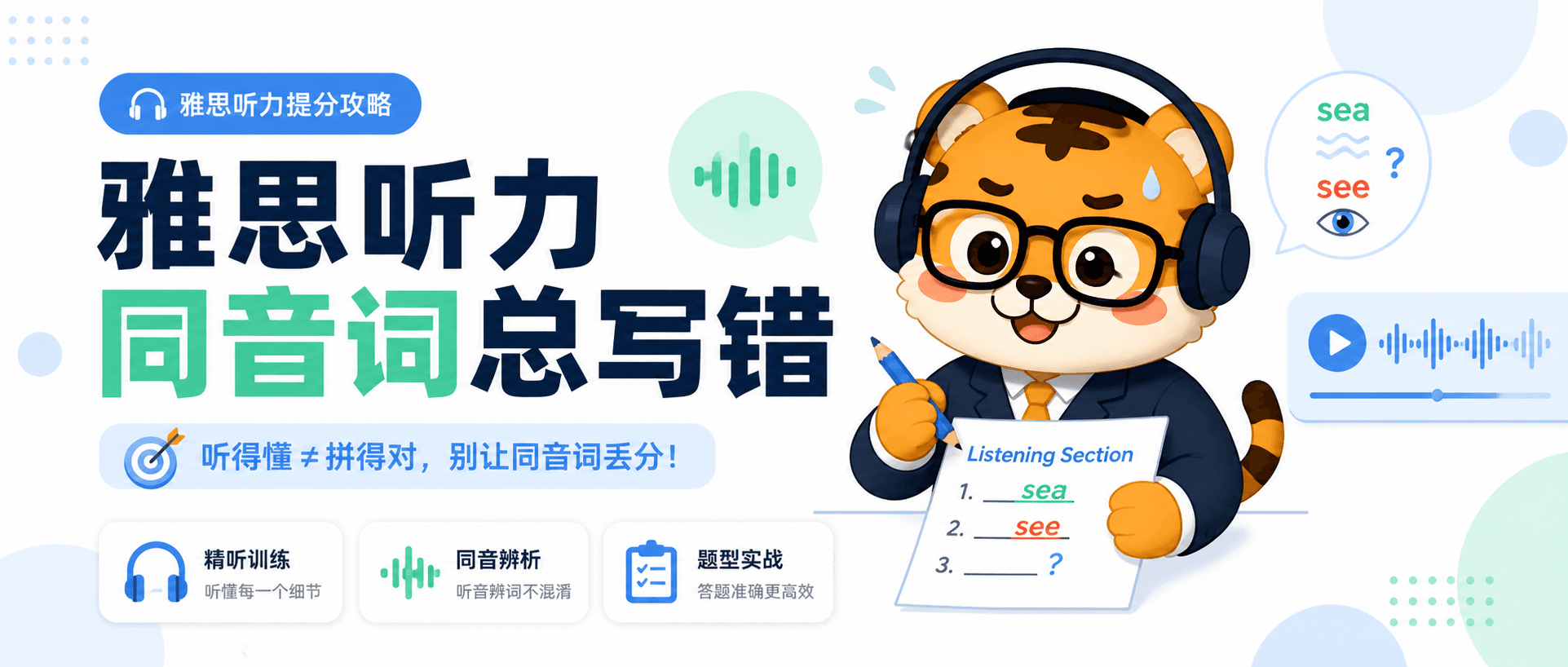
There is a particularly annoying type of error in IELTS Listening: you hear the answer in the audio, but when you look back, you’ve written down a different word. For example, words like sea vs. see, or site vs. sight. The sound is almost identical, yet the meaning is completely different. Others spell the word correctly but forget to add an "s" to a noun, and still lose that crucial one point.
To get a listening answer right, you have to pass two checkpoints. Your ears need to catch the sound, and your hand needs to write the correct spelling. The official IELTS preparation guide also reminds us that while spelling and grammar are checked, capitalization usually doesn't affect the score.
Place Homophones Back in Context
Do not simply select a word based on sound when a homophone appears in the recording. Look at the surrounding words to determine what part of speech and meaning the gap needs.
For example, in the sentence "The meeting will be held at the ___" (空格需填地点), if you hear /siː/, filling in "sea" isn't suitable because the context requires a place, not the sea. It is very easy to get confused with just one sound.
Now look at "The guide asked visitors to ___ the notice" (空格前有to,填动词). Here, the verb "see" sounds like /siː/ (see), which fits logically. "Sea" wouldn't even make grammatical sense here. When doing cloze tests, the sentence itself already provides half a clue—don't drop it.
Word Forms and Collocations Block Traps
Before you hear the answer, you can mark a small note on the gap: N for Noun, V for Verb, Adj for Adjective, and Numbers/Dates for self-correction.
For instance, in "a ___ of equipment" (a placeholder for equipment), the gap is usually a number or count noun. In "___ the form online" (fill in the blank plus "the form" online), it is highly likely a verb. Knowing what role the word plays in the sentence reduces the pool of candidate words.
Small Suffixes = Big Impact on Answers
Many people think their mistake is due to homophones, but upon review, they realize the issue is the suffix. In the audio, words like students, days, or prices might be said quickly. When writing, if you only leave student, day, or price, you miss the numeric distinction. Singular and plural forms are not prominent in rapid speech, but the question's grammar usually hints at the right form.
If the blank is preceded by words like "several", "many", or "two or more", check if the noun needs a plural form. If preceded by "a" or "one", you usually need the singular form. When you see "The ___ are open", the gap is usually a plural countable noun. If you aren't sure about the ending, write down the answer first, then cross-reference using the main subject-verb relation in the question.
Past tense endings are also easily missed. If the audio says "the event started in 1998", and the question changes to "The centre ___ in 1998", the answer needs to be "started". In training, separate the root word endings from the rest of the word and specifically circle the sounds for -s, -ed, and -ing.
Leave It Blank First, Fill It In Later
If you encounter a word you don't know how to spell during the exam, don't keep erasing and rewriting while the audio is playing. Write down the phonetic fragments you remember, immediately follow the next question. If one answer stalls you, the next two or three might be lost too.
After the recording ends, revisit the section in this order: First check word forms, then singular/plural and tense, and finally check alphabetical order. For example, you might write "enviroment" which sounds right but is missing an "n"; accommodation often gets misspelled with one "c" and one "m". In your error log, don't just write the correct word; keep a record of the version you wrote wrong so your eyes know where to avoid going next time.
Distinguish Between "Ear" and "Hand" Problems
Label the cause of each spelling error. Label it A if you didn't hear it. Label it B if you heard it but chose the wrong homophone. Label it C if you knew the answer but misspelled it. Label it D if you missed the plural form, past tense, or word count limit. You need different training methods for these four categories; copying down vocabulary blindly will waste your review time.
- Type A: Re-listen to the 5 seconds before and after. Observe linking, weak stress, and rhythm.
- Type B: Compare homophones within example sentences.
- Type C: Do dictation—write down what you hear immediately, then compare with the original text.
- Type D: Re-examine the question for limits like "ONE WORD," "NO MORE THAN TWO WORDS," and quantity indicators.
Pick ten of these specific errors every day. Cover the answers, attempt to write them, then open the transcript to check. Retake it the next day. Put the correct version into a short listening practice session on the third day. Only mark it as "mastered" when you get it right three times in a row.
Use Youshow IELTS for Short-Session Dictation Training
If you only have a spare ten or fifteen minutes, you can use the Youshow IELTS app for listening cloze tests and error reviews. After finishing a module, highlight the homophone errors specifically and re-listen to the original audio to confirm if the issue was lack of clarity, a misunderstanding, or a spelling slip. This is much more effective than brushing through a whole set of papers daily to find lost points.
Youshow IELTS also allows you to organize Listening, Reading, Speaking, and Writing practices into a single study plan, making it easier to review mistakes. You can search for "Youshow IELTS" in the Apple App Store or visit the official homepage at https://ielts.youshowedu.com/en. You don't need to spend a long time on listening training at once; listening to ten questions during your commute and spending a few minutes correcting spelling in the evening makes it easier to stick with.
Having many homophone errors doesn't mean your listening is fundamentally bad. When you check your answer by breaking down the sound, context, part of speech, ending, and spelling, you won't be guessing. The final confirmation is making sure the word you heard fits the question structure—this is how you secure those points.
Continue this topic
Related reading and practice

Turn blog tips into your actual IELTS training flow
Don't just read tips. On the platform you can put speaking practice, real test drills and review into one steady prep rhythm.
- AI speaking mock practice
- Structured Cambridge IELTS practice
- Continue your personal prep rhythm after signing in
- Extend to writing feedback and question banks later