IELTS Listening Map Questions: How to Stop Getting Lost—Prioritize Start Points, Directional Words & Turns
In IELTS Listening, there is one question type that looks harmless on the surface but can drive you absolutely insane.
Map questions.
When you first see the diagram, you might let out a sigh of relief, thinking: "Easy, I just have to walk along the route, find the classroom, shop, or park facilities." But when the audio starts—left, right, north, south, before, after, a turn here, a turn there—your mind starts scribbling all over the place like someone handed you a marker. The most frustrating part? Afterward, you feel like you understood every word, yet you keep getting them wrong.
I recently reviewed the official IELTS map labeling guidelines available online, as well as the British Council’s Listening test format and related tips. After going through all of this, I became even more convinced of one thing:
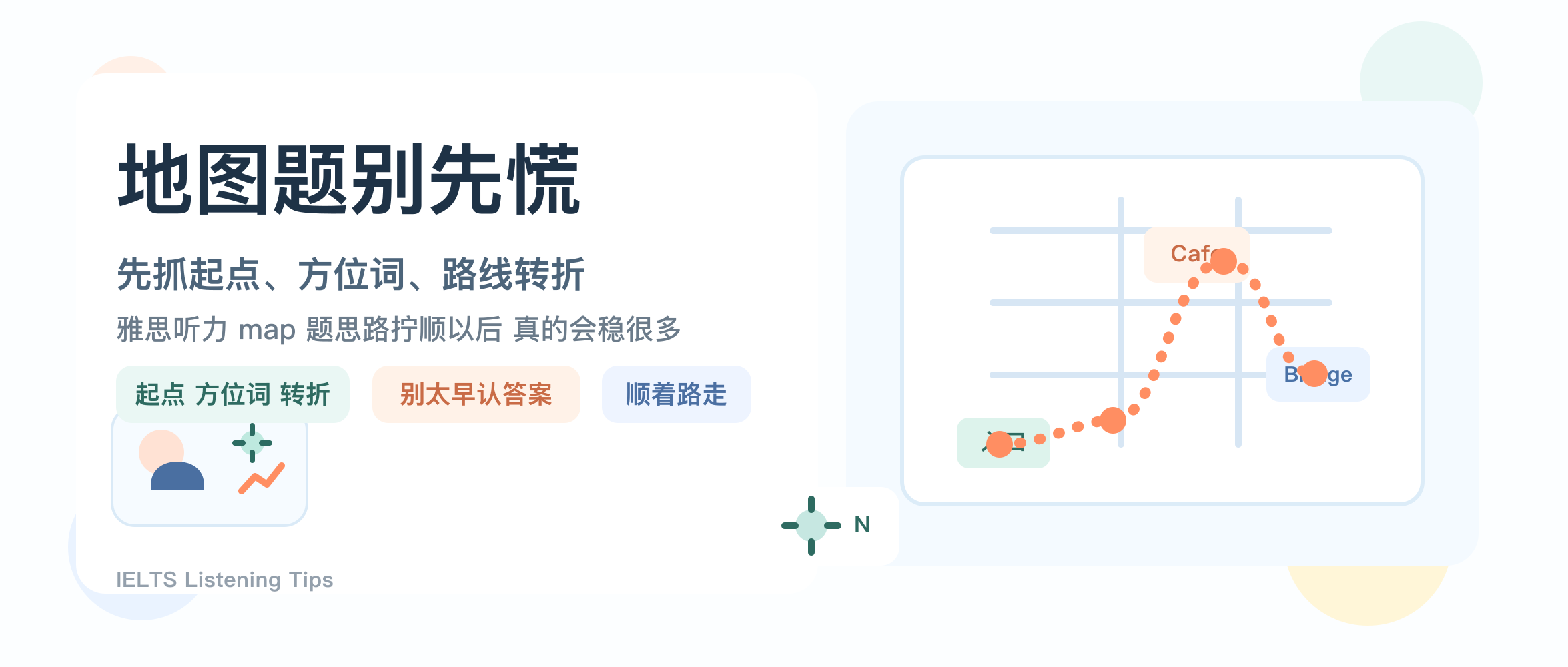
Getting spun around by IELTS Listening map questions isn’t necessarily because you have poor listening skills; often, it’s because you didn’t initially anchor your starting point, grasp directional words, or understand route transitions.
This question is very much like trying to navigate a new place with someone else. If your starting point is wrong, the rest of the journey is basically doomed. It really is.
Once You Settle the Start Point, Your Route Won't Drift from the First Sentence
The IELTS official article on map labeling is quite direct: identifying the speaker's starting point is crucial. Moreover, this start point doesn't just serve the first question; the speaker might loop back to that location in the following questions as well.
This reminder is incredibly valuable.
Many people rush to find answers as soon as the audio starts; their ears are frantically hunting for rabbits in the grass. However, the first few sentences of map questions rarely give away the answer immediately. Instead, they describe where the person is standing, where they are facing, and where they plan to go. If these sentences drift past you, when you later hear "library," "garden," or "bridge," those words just float in without taking root in a physical location.
So, don't just stare at the blanks or the options during those first few seconds before the test. First, scan the map for obvious markers of the start point: entrances, main doors, reception areas, main roads. And if there’s an arrow on the map, don't ignore it. It often indicates the exact location the speaker is about to move towards.
To put it plainly: don't rush to guess the destination in map questions. First, don't let yourself get lost.
Scan Directional Words and Relative Positions to Know Where to Turn
The IDP article also warns that map questions love to test "location words" (location words), such as next to, behind, across from, near, and under. If there is a compass, check it too, because directional words like north-east or south of often appear directly in the audio.
Many students skip this step, and I used to do it too. I’d think, "Who doesn't know left and right?" The problem is, recognizing a word during study isn't the same as identifying it on the fly during the exam. If two things on the map look similar, or if they are both on the same road, missing the distinction of "before the crossing" versus "after the crossing" will mean you get the question wrong.
My simple method is to look over the map before the audio starts and pick out the easiest points to pin down:
- Crossroads
- Doorway
- Stairs
- Riverbank
- Corner
- Already-written landmarks
If you have a few of these "nails" in your head first, the route in the audio will stick. Otherwise, if the speaker mentions "opposite the cafe," and you’re still wondering where the cafe is, you’ve already lost the second half of that sentence.
Clue: The Direction of Question Numbers Reduces Panic
There is a detail in the IELTS official map/planning tips that is easily overlooked but is a lifesaver. It mentions that if the question numbers are directly on the map, first observe the general direction they are arranged—for example, bottom-left to top-right, or from the entrance moving inward.
This takes seconds to do but saves a lot of panic.
Map questions aren't a completely random scattering of answers. Although the route may twist, it usually follows the order of the explanation. If you understand the movement direction of the question numbers beforehand, you will have a rough idea of where the speaker is going next. Even if you miss a sentence in the middle, you won't feel like you’ve fallen off the map.
Conversely, if you don't look at the general flow of the question numbers, you might find yourself in this situation: The audio says you are at Question 12 at the entrance, but the next second, the speaker has already gone to the back of the garden, while your mind is still spinning in the parking lot.
This isn't a listening comprehension issue; it’s a navigation issue. The difference between the two is significant. The former is a misunderstanding; the latter is being mentally disoriented.
Focus on Original Labels on the Map More Than Synonyms
The IELTS tips also mention a very practical point: map or plan names already given on the paper are usually spoken directly in the audio, rather than being replaced by synonyms.
This is a great way to anchor yourself.
Because long-term test practice can condition your brain to automatically look for "synonym replacements" (a strategy for Reading), but for map questions, you should often focus on the clearly visible labels on the map first. Words like information desk, playground, cafe, or bridge, if mentioned directly in the audio, act more like roadsigns. They might not be the answer, but they tell you where you are, not just the answer itself.
So, don't get excited and immediately write down an answer just because you recognize a familiar word. First, judge if it is serving as an answer or giving you a navigational update.
Once you master this nuance, your mind feels calmer. Otherwise, you tend to mistake "places you passed" for "places you need to fill in."
The Second Half of Route Turns Often Holds the Real Answer
Like other listening questions, map questions have distractors. The IDP article mentions that two locations might look similar (e.g., both on the same side of the road). The British Council tips also remind you to listen for words that tell you where to go and where to stop.
That is why many people don't fail on vocabulary, but on turning points.
When you hear the first half: “you’ll see the bank on your left”
You get excited, thinking: "That's it." But then the second half hits: “but don’t stop there, keep going until the end of the path”*
That bank immediately becomes a passing point, not the answer point.
So, don't lock onto the answer too early in map questions. The first half is more like a lead-in to pull you there; the second half is where the real target sits. Especially listen for words like but, then, after that, just beyond, at the end of. Your ears should perk up automatically at these moments. Many points are lost right here.
Drawing Your Path Easier Than Holding the Whole Route in Your Brain
I agree with a step in the British Council suggestions: draw your movement process directly on the map while listening. Don't think it's uncool; this step actually works.
The scariest part of map questions isn't that the information is too hard; it's that you are relying entirely on internal navigation. But in the exam, the seconds fly by. Listening, translating, and pinpointing locations mentally puts a heavy load on your brain. If you are willing to draw a small arrow along the route on the paper (or mentally), it will be much steadier than just struggling in your head.
For the paper-based test, you can draw directly on the test paper. For the computer-based test, simply follow the movement with your eyes and mentally draw a rough line for yourself. It doesn't need to be pretty; it just needs to keep you from getting lost.
This action might look a bit juvenile, but map questions don't care about looking cool. Getting the points is what matters; don't overthink it.
Analyzing Errors: Breaking Them Down into Location vs. Comprehension
I want to save this section for last because many people fail to progress in map questions because their review is too vague.
When you get a question wrong, don't just write: "I didn't understand."
You should break it down further:
- Was it the starting point?
- Did you get stuck when switching between north vs. left/right?
- Did you mistake a passing point for the answer?
- Did you fail to check the direction of the question numbers beforehand?
- Did you miss the second half after the transition?
- Did you hear the word but couldn't locate it on the map?
When you analyze the error, you know what to fix next time. Otherwise, it’s like patching a leak with superglue every time—you never actually fix the pipe.
If your practice notes for IELTS are scattered everywhere, I also recommend checking out Youshow IELTS. You can download it from the Apple App Store or visit their homepage at https://ielts.youshowedu.com/en. Although the name includes PTE, it works great for organizing IELTS Listening errors, drilling similar questions, and analyzing whether you consistently lose points at the start or during turns. You won't have to waste time flipping back and forth after every practice session.
Small-Scale Focused Practice Works Better Than Mindless Drills
If map questions are already making your brain spin, I don't suggest you continue grinding through full tests while expecting a sudden breakthrough.
It rarely happens. You will likely just get frustrated and want to throw your headphones at the wall after every session.
A more stable method is actually quite simple:
- Practice map or plan questions for several days in a row.
- Spend the first 30-40 seconds locating the starting point and orientation.
- Then, check the general direction of the question numbers.
- While listening, focus on the route words rather than prematurely locking in an answer.
- Afterward, review only one specific focus—for example, today focus on turning points, tomorrow focus on directional words.
This method isn't flashy, but it helps you regain your "hand feel."
Plus, there’s a benefit to map questions: once you master these few actions, your score recovers faster than you expect. They don't test wildly new tricks every time; many of the traps are actually just standard.
Map Questions Don't Become Stable Because You Suddenly Understand Everything
I’m starting to feel that improvement in IELTS Listening map questions usually doesn't come from a sudden explosion of vocabulary or gaining some mysterious talent.
The more common scenario is that you finally stopped drifting off at the very beginning.
For example, you stabilize the starting point. For example, you clearly recognize directional words. For example, you know the general movement of the question numbers. And most importantly, you stop mistaking passing points for answers immediately. And you are willing to wait that extra half-second for the transition.
These actions aren't cool or clever; they are sometimes a bit clumsy.
But for a test like Map Questions, sometimes the clumsy methods are the ones that save your life.
So, if you’ve been getting a stiff neck every time you see a map in the exam, don't rush to conclude that you are bad at listening. First, try to master these three things: starting points, directional words, and route transitions. Often, you aren't completely lost; you just lost your way during the walk.
Continue this topic
Related reading and practice

Turn blog tips into your actual IELTS training flow
Don't just read tips. On the platform you can put speaking practice, real test drills and review into one steady prep rhythm.
- AI speaking mock practice
- Structured Cambridge IELTS practice
- Continue your personal prep rhythm after signing in
- Extend to writing feedback and question banks later