what is a ielts exam: IELTS Exam Sections, Scores, and Test Types
If you are planning to study, work, or move abroad, you have probably seen the words IELTS exam many times. The first search can be a little confusing. Some pages talk about vocabulary, some talk about speaking templates, and some use Academic and General Training as if they were the same test.
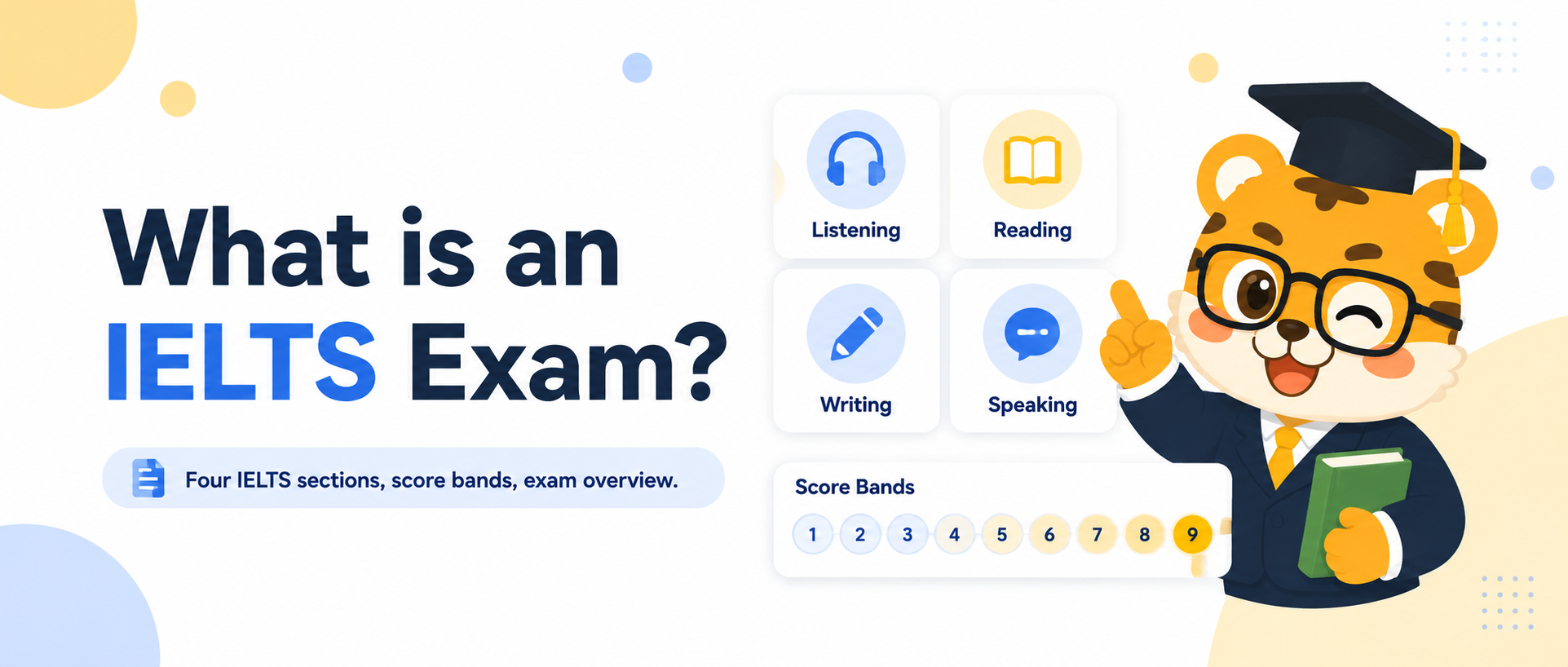
IELTS means International English Language Testing System. It checks how well you can use English in real study, work, and daily situations. The exam has four parts: Listening, Reading, Writing, and Speaking. You do not need to be perfect in every sentence. You need to understand information and communicate your ideas clearly enough for your goal.
The four IELTS sections create one overall band score
Listening, Reading, Writing, and Speaking are scored separately. Listening and Reading use questions, while Writing and Speaking ask you to produce English. The Listening, Reading, and Writing tests are usually taken together. The Speaking test may be on the same day or on another nearby day, depending on the test centre.
You can take IELTS on paper or on a computer in many places. The format feels different, but the skills and scoring goals are generally the same. A computer test does not turn IELTS into an easier exam. You still need to manage time, understand the task, and give accurate answers.
Each skill receives a band score from 0 to 9. Half bands such as 6.5 and 7.5 are common. Your Overall Band Score is calculated from the four skill scores. For example, 7.0 in Listening, 6.5 in Reading, 6.0 in Writing, and 6.5 in Speaking gives an overall 6.5.
Many universities and visa routes also ask for a minimum score in each skill. A person with a good overall score can still miss a requirement because Writing or Speaking is too low. Always check both the overall score and the minimum score for every section.
Academic and General Training serve different purposes
IELTS Academic is commonly used for university study, postgraduate courses, and some professional registration. Its Reading texts are closer to academic articles. In Writing Task 1, you may describe a chart, process, map, or diagram. Writing Task 2 usually asks you to discuss an opinion, problem, or social issue.
IELTS General Training is often used for migration, work, or non-degree training. Its Reading texts can include notices, advertisements, workplace documents, and general articles. In General Training Writing Task 1, you usually write a letter. Listening and Speaking are shared areas, but the Reading and Writing sections are different.
There are also tests such as IELTS for UKVI and IELTS Life Skills. They are designed for particular application routes and may be accepted by different organisations. Before paying for a test, read the exact requirement from your university, employer, or visa authority. Check the test type, location, date, and fee at the same time.
Listening and Reading require more than memorised vocabulary
In Listening, the recording is normally played once. An answer can depend on spelling, a number, a plural ending, or a correction made by the speaker. You may know a word on paper and still fail to recognise it quickly in a recording.
A useful habit is to read the question first and predict the answer type. Is it probably a name, place, number, noun, or adjective? Then listen to the words around the answer, not only one keyword. Speakers often use a paraphrase instead of repeating the words in the question.
Reading has a fixed time limit. The passage may use a synonym or a different sentence structure instead of the exact phrase in the question. When you find a similar word, read enough of the surrounding sentence to check the meaning, range, and relationship between ideas. This is especially important for True, False, Not Given questions and multiple-choice questions.
Writing and Speaking improve through repeatable habits
Writing scores depend on task response, organisation, vocabulary, and grammar. A clear paragraph with one main idea, an explanation, and a specific example is often easier to control than a paragraph packed with difficult words. In Task 1, do not copy every number. Select the main trend, biggest difference, or important comparison.
Speaking has three parts. Part 1 covers familiar topics such as home, study, work, and free time. Part 2 gives you a task card and asks you to speak for one to two minutes. Part 3 asks broader questions about reasons, effects, and opinions.
You can pause briefly or change your wording in the Speaking test. The bigger problem is giving only one short sentence for every question, or repeating a memorised answer that does not fit the topic. Record yourself for one or two minutes. Listen for tense changes, repeated words, and sentences that stop before the idea is complete. Fixing one small habit at a time is easier to continue.
Your preparation plan should start with the actual requirement
First find the target score and the correct IELTS test type. Then complete a short practice test for all four skills. Listening and Reading errors can be counted. Writing and Speaking need a closer review of task completion, organisation, grammar, and the ability to explain an idea.
Keep an error log with the reason for each mistake. Was the problem spelling, a missed paraphrase, poor time control, a weak example, or a tense error? A list of wrong answers is less useful when it does not show why the answer went wrong. Do a full practice test regularly, but use shorter sessions to repair the specific weak points.
If you want one place for daily practice, YoushowIELTS, also known as 优秀雅思, can help you combine Listening, Reading, Writing, and Speaking work. It includes speaking simulations, writing feedback, practice materials, and error review tools. You can visit the official website at https://ielts.youshowedu.com and check whether its features match your test type and target score.
An IELTS exam is a four-skill English test with separate band scores and one overall score. Once you know which version you need and what each section asks you to do, the preparation becomes much easier to organise. The first useful step is simple: check the requirement carefully, then practise all four skills with your target score in mind.
Continue this topic
Related reading and practice

Turn blog tips into your actual IELTS training flow
Don't just read tips. On the platform you can put speaking practice, real test drills and review into one steady prep rhythm.
- AI speaking mock practice
- Structured Cambridge IELTS practice
- Continue your personal prep rhythm after signing in
- Extend to writing feedback and question banks later